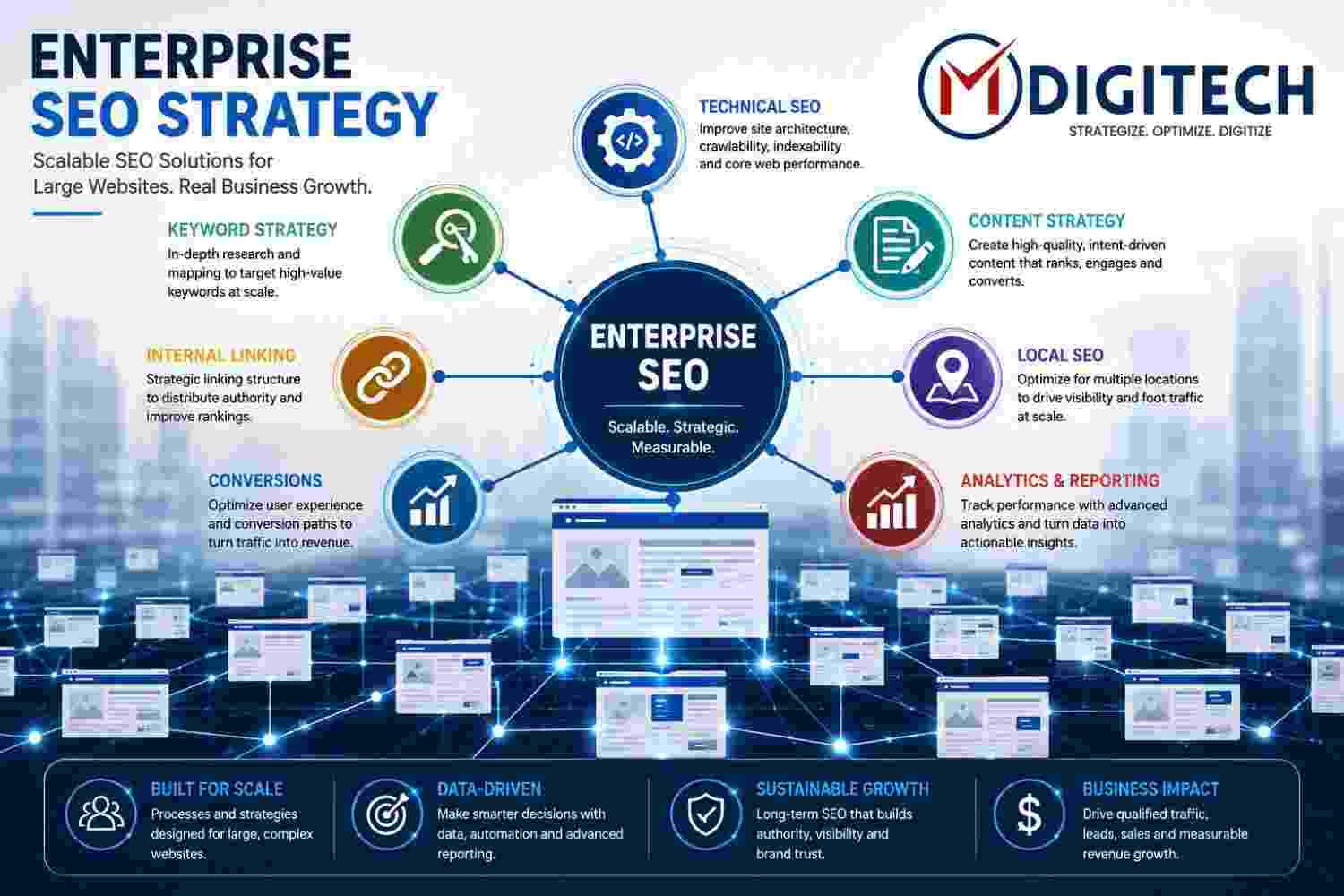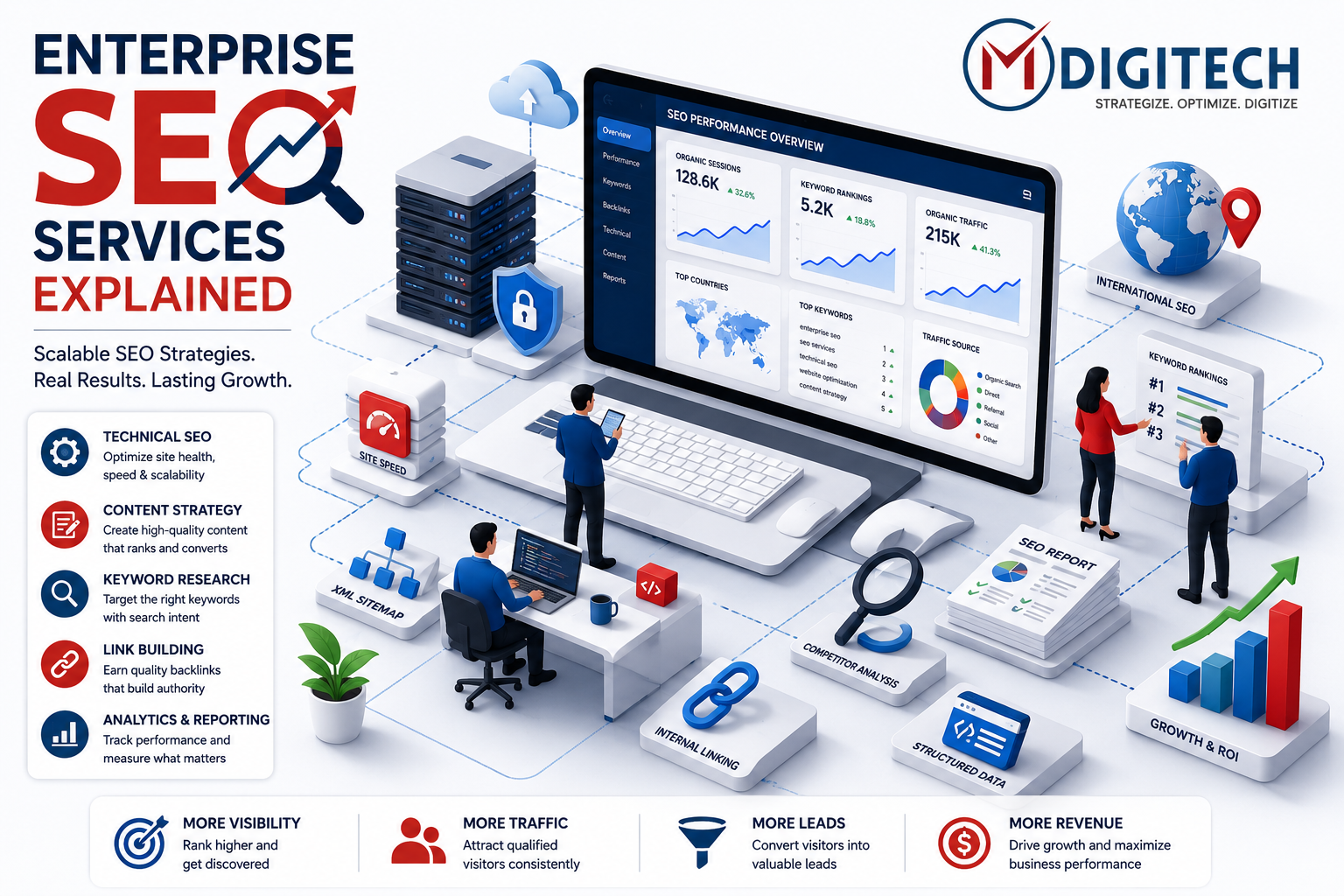
Enterprise SEO helps large organizations improve organic visibility across thousands or even millions of webpages, products, locations, categories, and customer journeys. Unlike small-business SEO, enterprise search optimization requires centralized strategy, technical control, scalable content systems, cross-team coordination, and continuous performance analysis. Consequently, businesses need processes that can handle complexity without sacrificing search quality or user experience. A strong enterprise SEO program connects technical health, content relevance, internal linking, structured data, authority, and conversion opportunities so organic search can support sustainable business growth.
What Are Enterprise SEO Services?
Enterprise SEO services focus on improving organic search performance for large websites with extensive content, multiple departments, numerous products, several locations, or complex technology platforms.
These services combine strategic planning with technical execution. Moreover, enterprise SEO teams often coordinate with developers, content teams, product managers, designers, executives, and marketing specialists.
How Enterprise SEO Differs From Traditional SEO
Traditional SEO may focus on optimizing hundreds of pages, while enterprise SEO can involve tens of thousands or millions of URLs. Therefore, manual optimization alone cannot provide efficient results.
Enterprise programs rely heavily on scalable systems, automation, templates, governance, technical controls, and prioritization. Instead of optimizing every page individually, teams identify patterns that can improve large groups of pages simultaneously.
For example, improving a product-page template can strengthen thousands of URLs at once. Similarly, correcting an internal linking structure can improve the discoverability and authority flow across an entire website.
Why Scale Changes SEO Strategy
Large websites create problems that smaller websites rarely face. Duplicate content, crawl inefficiencies, indexation problems, faceted navigation, JavaScript rendering, international variations, and outdated pages can quickly become significant.
However, scale also creates major opportunities. A single strategic improvement can influence thousands of pages and generate substantial organic growth.
Key Components of Enterprise SEO
A successful enterprise SEO program covers multiple disciplines. Each component supports another, creating a connected search ecosystem rather than isolated optimization tasks.
Technical SEO
Technical SEO creates the foundation for search visibility. Enterprise websites require careful management of crawling, indexing, rendering, site architecture, redirects, canonicalization, XML sitemaps, pagination, structured data, and page performance.
Furthermore, technical teams must monitor changes continuously. A website migration, platform update, filter implementation, or template modification can create thousands of SEO problems within hours.
Important technical priorities include:
- Crawl budget management
- Indexation control
- Canonical URL implementation
- Redirect management
- JavaScript rendering
- Mobile usability
- Core page experience
- XML sitemap accuracy
- Structured data
- HTTPS security
- Duplicate URL prevention
- International targeting
Consequently, technical SEO should remain integrated with development workflows instead of operating as a separate marketing activity.
Enterprise Keyword Strategy
Large websites require extensive keyword research and classification. Rather than creating isolated keyword lists, SEO teams should organize terms according to search intent, customer journey, product relationships, locations, and business priorities.
For example, informational searches may support awareness, while commercial searches can indicate stronger purchase intent. Transactional searches often require optimized product, category, or service pages.
Moreover, keyword mapping prevents multiple pages from competing for the same search intent. It also helps teams identify missing content opportunities and prioritize pages with the greatest commercial potential.
Content Strategy for Enterprise Websites
Content plays a central role in enterprise SEO because large websites need useful, relevant information at scale. However, producing more content does not automatically improve organic performance.
Search Intent and Content Relevance
Every page should satisfy a specific user need. Content teams should evaluate whether a visitor wants information, comparison, evaluation, navigation, or a transaction.
Consequently, each page should provide a clear answer or solution without unnecessary repetition.
Strong content should include relevant entities, supporting concepts, useful examples, clear organization, and appropriate calls to action. Furthermore, content should reflect the needs of the intended audience instead of simply targeting keywords.
Content Governance
Large organizations often have multiple writers and departments producing content. Without governance, quality and messaging can become inconsistent.
An enterprise content framework should establish:
- Editorial standards
- Search intent requirements
- Brand guidelines
- Internal linking rules
- Metadata standards
- Content review procedures
- Updating schedules
- Ownership responsibilities
- Quality controls
Therefore, governance helps maintain consistency while allowing different teams to publish efficiently.
Content Refresh Programs
Older pages can lose visibility when information becomes outdated or competitors publish stronger resources. A structured refresh program helps identify declining pages and prioritize improvements.
Instead of automatically rewriting everything, teams should analyze organic traffic, rankings, conversions, backlinks, engagement signals, and search intent. Consequently, resources can focus on pages with genuine growth potential.
Enterprise Site Architecture
Site architecture determines how search engines and users move through a website. A logical structure makes important pages easier to reach and helps distribute internal authority effectively.
Creating Logical URL Structures
URLs should communicate hierarchy clearly. Categories, subcategories, products, services, and locations should follow predictable patterns when appropriate.
However, enterprise websites often accumulate unnecessary parameters, filters, duplicate paths, and legacy URLs. These elements can create massive crawling and indexing challenges.
A controlled URL framework reduces duplication and helps search engines focus on valuable pages.
Internal Linking at Scale
Internal links help users navigate related information while connecting important pages throughout the site.
Enterprise websites should develop systematic internal linking strategies based on topical relationships, business priorities, user journeys, and page importance. Moreover, automated recommendations can assist with scale when teams maintain quality controls.
Strong internal linking can connect informational content with commercial pages, helping prospects move naturally from research toward conversion.
Technical Challenges in Enterprise SEO
Large websites create technical challenges that require specialized processes and monitoring.
Crawl and Indexation Management
Search engines cannot treat every URL equally. Enterprise websites may generate thousands of URLs through filters, search functions, sorting parameters, session identifiers, and duplicate pathways.
Therefore, SEO teams must determine which URLs deserve crawling and indexing.
Useful controls can include canonical tags, robots directives, parameter handling, internal linking improvements, sitemap management, and carefully designed navigation systems.
JavaScript SEO
Modern enterprise platforms often depend heavily on JavaScript. Although search engines can process JavaScript, implementation problems can still affect rendering, content availability, links, and indexation.
SEO specialists should work with developers to ensure important content and navigation elements remain accessible to search engines and users.
Website Migrations
Enterprise migrations represent major SEO risks because thousands of URLs may change simultaneously.
A migration plan should include URL mapping, redirect testing, canonical checks, sitemap updates, staging reviews, monitoring, and post-launch validation.
Moreover, teams should compare organic performance before and after launch to identify unexpected losses quickly.
International Enterprise SEO
Organizations operating across countries require additional SEO considerations. International websites may use different domains, subdomains, subdirectories, languages, currencies, and regional content.
International Targeting
Search engines need clear signals about which content serves each market. Language and regional relevance should remain consistent across page content, URLs, navigation, metadata, and structured signals.
In addition, hreflang implementation can help search engines serve appropriate regional versions when multiple localized pages exist.
Localization vs. Translation
Direct translation does not always create effective localized content. Search behavior, terminology, cultural preferences, purchasing habits, and regulations can differ between markets.
Consequently, enterprise teams should localize important content instead of translating every page mechanically.
Enterprise Local SEO
Organizations with hundreds or thousands of locations need scalable local SEO systems.
Each location should provide accurate information, relevant services, unique content where appropriate, and clear connections to the broader website architecture.
Location Page Optimization
Location pages should provide genuine local value rather than repeating identical templates with city names substituted.
Useful elements can include local services, operating information, directions, area details, unique offerings, customer resources, and locally relevant content.
Moreover, location pages should connect logically with regional and corporate pages.
Managing Multiple Locations
Large organizations need centralized governance for business information. Inconsistent addresses, phone numbers, categories, hours, or location details can create customer confusion and weaken local search signals.
A standardized process makes updates faster and reduces errors across the network.
Enterprise SEO and Content Marketing Funnels
SEO should not stop when someone reaches a website. Organic search can support every stage of the marketing funnel when businesses align content with customer intent.
Awareness Stage
Early-stage prospects often search for definitions, problems, solutions, trends, and educational information.
SEO content should answer these questions clearly while introducing the business’s expertise without forcing an immediate sales pitch.
Consideration Stage
Prospects evaluating solutions need comparisons, feature explanations, use cases, pricing information, alternatives, and detailed service pages.
Therefore, middle-funnel content should address objections and help visitors evaluate available options.
Conversion Stage
High-intent visitors need confidence before taking action. Strong service pages, product pages, demonstrations, testimonials, FAQs, guarantees, and transparent processes can reduce hesitation.
Clear calls to action should guide qualified visitors toward purchases, consultations, applications, or other valuable actions.
Retention Stage
SEO can also support existing customers. Helpful documentation, support resources, product education, troubleshooting content, and account resources can strengthen customer satisfaction.
Consequently, organic search can contribute to retention and customer lifetime value rather than focusing exclusively on acquisition.
Enterprise SEO Analytics and Reporting
Measurement becomes more important as website complexity increases. Enterprise teams need reliable data that connects search performance with commercial outcomes.
Important SEO Metrics
Useful metrics include:
- Organic revenue
- Qualified organic leads
- Organic conversion rate
- Non-branded search visibility
- Keyword performance
- Indexed pages
- Crawl efficiency
- Organic traffic
- Landing-page performance
- Assisted conversions
- Customer acquisition cost
- Return on marketing investment
Traffic alone rarely provides enough information. A page can attract thousands of visitors while producing little commercial value.
Connecting SEO With Revenue
Enterprise organizations should connect SEO data with sales and customer information whenever technically possible.
For example, a company can evaluate which organic landing pages generate qualified leads and which categories produce revenue. Consequently, SEO teams can prioritize initiatives based on business value rather than rankings alone.
Automation in Enterprise SEO
Automation helps enterprise teams manage repetitive SEO tasks efficiently. However, automation should support human judgment rather than replace strategic decision-making.
Automated systems can help identify broken links, missing metadata, duplicate pages, redirect chains, indexing anomalies, and content gaps.
Furthermore, templates can automate certain optimization elements across large page groups.
Where Automation Works Best
Automation works particularly well for repetitive and rule-based processes. These can include:
- Technical monitoring
- Sitemap generation
- Broken-link detection
- Metadata validation
- Redirect monitoring
- Internal-link recommendations
- Content inventory management
- Performance alerts
- SEO quality checks
Human oversight remains essential because automated rules can produce incorrect recommendations when page context varies.
Enterprise SEO and AI Search
Search behavior continues to evolve as users interact with search engines through increasingly sophisticated interfaces and AI-powered experiences.
Enterprise organizations should therefore focus on clear information architecture, authoritative content, accurate facts, strong entity relationships, and useful answers.
Content should provide genuine value instead of attempting to manipulate search systems. Moreover, organizations should maintain consistent information across important digital properties so search systems can connect brands, products, services, locations, and expertise accurately.
How to Build an Enterprise SEO Team
Enterprise SEO requires cooperation across multiple functions. A typical structure may include:
- SEO strategists
- Technical SEO specialists
- Content strategists
- Writers and editors
- Developers
- Data analysts
- UX specialists
- Local SEO specialists
- Digital PR professionals
- Product managers
However, team structure should match organizational needs. Smaller enterprise departments may combine responsibilities, while larger organizations may create dedicated specialists for each discipline.
Clear ownership prevents tasks from falling between departments.
How to Prioritize Enterprise SEO Projects
Large organizations usually have more SEO opportunities than available resources. Prioritization prevents teams from spending months on low-impact improvements.
A useful framework evaluates:
- Potential organic impact
- Business value
- Implementation effort
- Technical risk
- Search demand
- Competitive pressure
- Scalability
- Customer impact
High-impact, low-effort opportunities often deserve immediate attention. Meanwhile, major technical projects should receive careful planning because implementation mistakes can affect large sections of the website.
Common Enterprise SEO Mistakes
Enterprise organizations can create SEO problems even when they have substantial marketing resources.
Publishing Too Much Low-Value Content
More pages do not necessarily create more organic visibility. Thin, repetitive, or overlapping content can dilute resources and create indexation challenges.
Quality should remain the priority.
Ignoring Technical SEO
Strong content cannot compensate for severe crawling, rendering, or indexing problems. Therefore, technical health should receive continuous attention.
Creating Duplicate Pages
Filters, regional variations, product combinations, and outdated URLs can generate thousands of duplicate pages.
A clear URL and indexation strategy helps control this problem.
Separating SEO From Development
SEO recommendations often require technical implementation. When SEO teams operate separately from developers, important improvements can remain unfinished.
Close collaboration produces faster and more reliable execution.
Focusing Only on Rankings
Rankings matter, but they represent only one part of business performance. Organic conversions, revenue, qualified leads, and customer value provide stronger commercial indicators.
How Long Does Enterprise SEO Take?
Enterprise SEO rarely produces meaningful transformation overnight. Technical improvements can create relatively quick gains, while broader content and authority initiatives may require longer periods.
The timeline depends on website size, competition, technical condition, content quality, domain authority, implementation speed, and search demand.
Consequently, enterprise teams should establish milestones instead of relying on a single deadline. Early milestones may focus on technical improvements, followed by visibility growth, qualified traffic, conversions, and revenue.
How Much Do Enterprise SEO Services Cost?
Enterprise SEO pricing varies substantially because organizations require different levels of technical work, content production, strategic support, and reporting.
Smaller enterprise programs may cost several thousand dollars per month, while large multinational programs can require significantly higher investment.
Pricing can depend on:
- Website size
- Number of markets
- Number of locations
- Content requirements
- Technical complexity
- Competition
- Reporting needs
- Team size
- Consulting requirements
- Implementation support
A low-cost package may not provide enough resources for a complex enterprise environment. Conversely, a large budget does not guarantee results without effective strategy and execution.
How to Evaluate an Enterprise SEO Provider
Organizations should evaluate providers based on capabilities rather than promises.
Look for clear processes, transparent reporting, technical expertise, scalable content systems, measurable objectives, and strong communication.
Ask potential providers how they handle migrations, indexation problems, international SEO, content governance, internal linking, technical audits, and performance measurement.
Moreover, request clarity around responsibilities. A provider should explain which tasks its team handles and which tasks require internal developers, content teams, or other departments.
A strong partnership should create accountability on both sides.
The Business Value of Enterprise SEO
Enterprise SEO can create substantial long-term value because organic search can generate qualified traffic without requiring payment for every visit.
However, the greatest value comes from connecting SEO with broader business objectives.
Better search visibility can increase qualified traffic. Stronger landing pages can improve conversions. Improved content can support prospects at different funnel stages. Technical improvements can increase the efficiency of large websites.
Consequently, enterprise SEO can influence acquisition, brand visibility, customer experience, and revenue simultaneously.
Frequently Asked Questions
1. What does enterprise SEO include?
Enterprise SEO typically includes technical optimization, keyword strategy, content management, site architecture, internal linking, international SEO, local SEO, structured data, analytics, and ongoing performance monitoring. Because large websites create complex challenges, enterprise programs also emphasize governance, automation, scalable workflows, and collaboration between SEO, development, content, product, and marketing teams.
2. Who needs enterprise SEO services?
Large organizations with extensive websites, multiple locations, thousands of products, international markets, or complex digital platforms can benefit from enterprise SEO. The need depends more on website complexity than company revenue. A growing organization may require enterprise processes once its website becomes too large for manual optimization and decentralized SEO management.
3. How is enterprise SEO different from regular SEO?
Enterprise SEO operates at much larger scale. Instead of optimizing a limited number of pages, teams may manage thousands or millions of URLs. Therefore, automation, governance, technical controls, templates, data analysis, and cross-functional collaboration become essential. Enterprise SEO also requires stronger processes for migrations, international markets, and large content operations.
4. Why is technical SEO important for enterprise websites?
Technical SEO helps search engines crawl, render, and index valuable pages efficiently. Enterprise websites can generate enormous numbers of duplicate, filtered, parameter-based, or outdated URLs. Consequently, technical problems can affect large portions of a website. Strong technical controls help protect organic visibility while improving website usability and maintainability.
5. How long does enterprise SEO take to produce results?
Results depend on competition, website condition, implementation speed, content quality, authority, and the scale of planned changes. Technical fixes may create improvements relatively quickly, while content and authority initiatives can take longer. Therefore, enterprise teams should measure progress through staged milestones involving technical health, visibility, qualified traffic, conversions, and revenue.
6. Can enterprise SEO increase revenue?
Enterprise SEO can contribute to revenue by increasing qualified organic traffic and improving the conversion path. However, traffic growth alone does not guarantee financial improvement. Businesses should connect organic landing pages with leads, sales, transactions, and customer value. This approach helps teams prioritize SEO initiatives that contribute directly to commercial performance.
7. Does enterprise SEO require a large internal team?
Not necessarily. Organizations can combine internal specialists with external strategic or technical support. The ideal structure depends on website complexity, internal resources, development capacity, content volume, and business goals. Regardless of team size, clear ownership remains important because SEO tasks often require coordination between marketing, technology, content, analytics, and product teams.
8. How does content marketing support enterprise SEO?
Content marketing supports enterprise SEO by addressing different search intents throughout the customer journey. Educational content can attract early-stage prospects, comparison content can support evaluation, and service or product pages can encourage conversions. Moreover, strong internal linking can connect these resources and create a logical path from organic discovery to business action.
9. What metrics should enterprise SEO teams track?
Enterprise teams should track organic revenue, qualified leads, conversions, organic traffic, search visibility, landing-page performance, indexed pages, crawl efficiency, and conversion rates. Rankings can provide useful diagnostic information, but they should not become the only performance measure. Connecting SEO data with business outcomes creates stronger prioritization and accountability.
10. Is enterprise SEO worth the investment?
Enterprise SEO can provide strong value when organizations have substantial organic search demand and a website capable of capturing that demand. The investment becomes more meaningful when teams connect SEO improvements with qualified traffic, conversions, revenue, and customer value. However, businesses should prioritize measurable opportunities rather than spending heavily on activities without clear commercial relevance.
Conclusion
Enterprise SEO requires more than optimizing individual webpages. Large organizations need scalable technical systems, structured content strategies, logical architecture, strong internal linking, accurate analytics, governance, and cross-functional execution. Moreover, successful programs connect search visibility with customer journeys and measurable business outcomes. When organizations prioritize high-impact opportunities, control technical complexity, and align SEO with marketing and revenue objectives, organic search can become a powerful long-term growth channel.