Enterprise businesses compete across thousands of webpages, multiple markets, and highly competitive search results. As websites grow, search engine optimization becomes more complex and demands a structured strategy that supports scalability, consistency, and measurable performance. Enterprise SEO services address these challenges by combining technical optimization, high-quality content, data analysis, and ongoing improvements. Moreover, an effective content marketing funnel transforms increased visibility into qualified leads and loyal customers, ensuring every optimization effort contributes to sustainable business growth.
What Are Enterprise SEO Services?
Enterprise SEO services focus on improving the organic search performance of large websites with hundreds, thousands, or even millions of pages. Unlike traditional SEO, enterprise strategies prioritize scalability, automation, collaboration, and long-term growth.
Large organizations often manage multiple products, locations, business units, or international markets. Consequently, SEO requires coordinated planning across technical teams, content creators, developers, and marketing professionals.
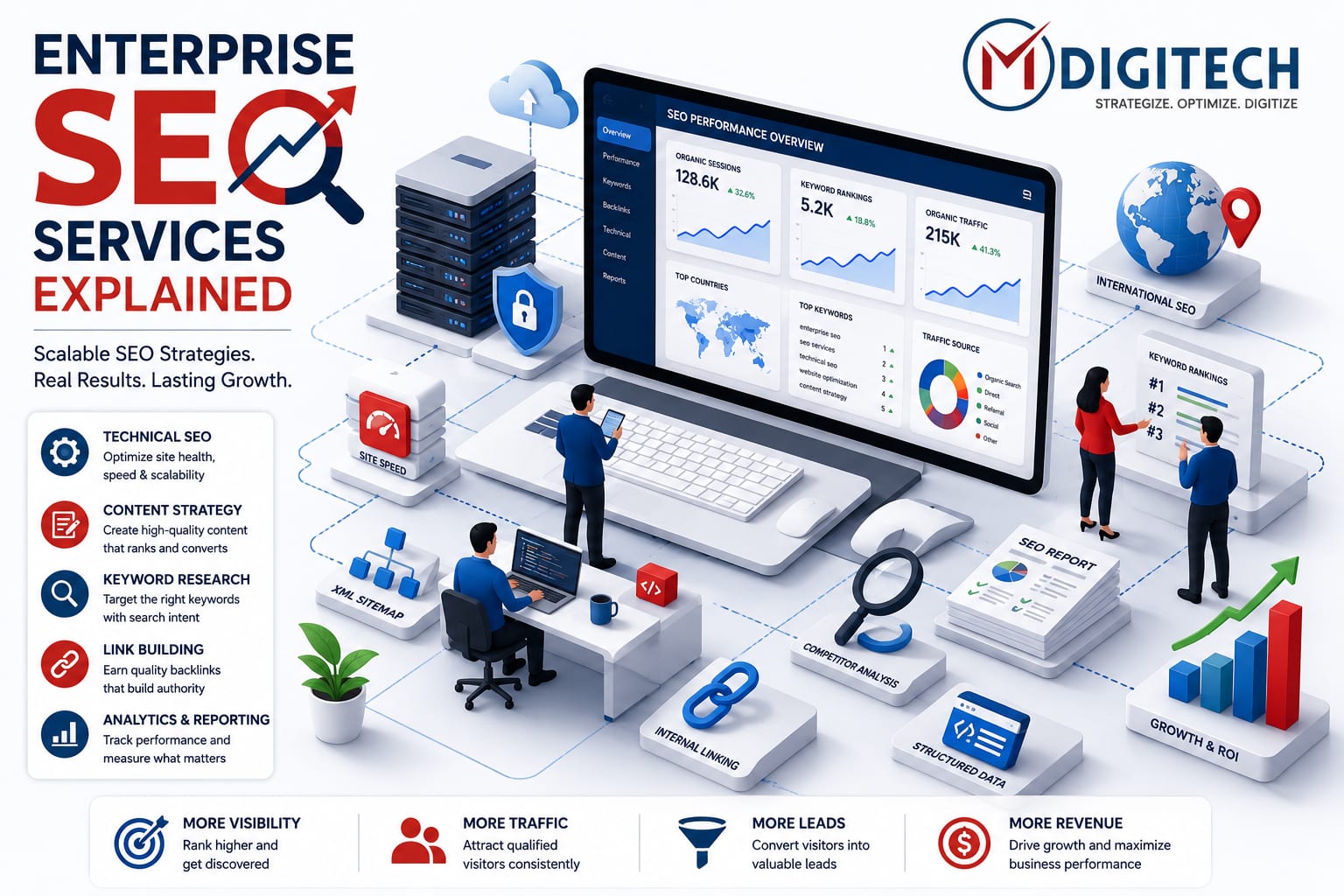
Enterprise SEO commonly includes:
- Technical SEO optimization
- Large-scale keyword research
- Content strategy
- Internal linking
- Website architecture improvements
- Schema implementation
- Analytics and reporting
- International SEO
- Local SEO management
- Conversion optimization
Rather than optimizing isolated pages, enterprise SEO strengthens the entire website ecosystem.
Why Enterprise SEO Differs from Traditional SEO
Although the principles remain similar, enterprise websites introduce challenges that smaller websites rarely encounter.
Large websites frequently include:
- Thousands of indexed pages
- Multiple content contributors
- Several product categories
- Complex navigation
- Multiple target audiences
- Regional or global markets
Therefore, every optimization must support both user experience and search engine efficiency without disrupting business operations.
Scalability Becomes the Primary Goal
Enterprise websites constantly expand. New products, services, locations, and resources require ongoing optimization.
Instead of making isolated improvements, enterprise SEO develops repeatable systems that maintain consistency across the entire website.
These systems often include:
- Standardized page templates
- Automated metadata generation
- Content governance
- Technical quality controls
- Internal linking frameworks
As a result, businesses maintain quality while supporting continuous growth.
Multiple Departments Must Work Together
SEO rarely succeeds without collaboration.
Marketing teams create campaigns, developers manage website functionality, designers improve user experience, and leadership defines business priorities.
Consequently, enterprise SEO requires clear communication and shared objectives across every department.
Core Components of Enterprise SEO
Strong enterprise SEO combines several specialized disciplines into one coordinated strategy.
Technical SEO
Technical optimization creates the foundation for every successful campaign.
Without strong technical performance, even outstanding content struggles to achieve maximum visibility.
Technical priorities include:
- Crawlability
- Index management
- XML sitemaps
- Site speed
- Core Web Vitals
- Mobile usability
- HTTPS security
- Structured data
- Canonical tags
- Redirect management
Moreover, routine technical audits identify problems before they affect search performance.
Content Strategy
Content remains one of the strongest drivers of organic growth.
However, enterprise businesses require structured planning instead of random publishing schedules.
Effective content strategies include:
- Topic clusters
- Search intent alignment
- Editorial calendars
- Content refresh schedules
- Product content
- Educational resources
- Industry insights
- Supporting landing pages
Each content asset should contribute to broader business objectives while answering customer questions.
Keyword Research at Scale
Enterprise keyword research extends beyond selecting individual search terms.
Instead, marketers organize keywords into logical categories that support website architecture and customer journeys.
Research typically considers:
- Search intent
- Commercial value
- Competition
- Seasonal demand
- Geographic targeting
- Customer lifecycle
- Existing rankings
Consequently, businesses avoid duplicate content while improving topical authority.
Website Architecture Matters More Than Ever
Large websites require organized navigation that supports both visitors and search engines.
Poor architecture creates crawling issues, duplicate pages, and confusing navigation.
Building Logical Site Structures
A well-organized website groups related topics together, making information easier to locate.
Strong architecture includes:
- Clear navigation menus
- Category hierarchies
- Logical URL structures
- Consistent breadcrumbs
- Related content sections
Furthermore, organized structures strengthen internal linking opportunities throughout the website.
Internal Linking Supports Authority
Internal links distribute authority between pages while helping users locate valuable resources.
Effective internal linking should:
- Connect related topics
- Support important landing pages
- Reduce orphan pages
- Improve navigation
- Encourage longer sessions
Balanced internal linking also helps search engines identify priority pages.
Content Quality Drives Sustainable Growth
Publishing more pages alone rarely produces better rankings.
Instead, enterprise websites should prioritize valuable content that satisfies user intent.
Creating Helpful Content
Every page should solve a problem, answer a question, or support a purchasing decision.
Helpful content often includes:
- Industry insights
- Buying considerations
- Service information
- Educational resources
- Product comparisons
- Frequently asked questions
Moreover, consistent publishing strengthens authority across important subject areas.
Refreshing Existing Content
Older pages often contain valuable authority but outdated information.
Refreshing content may involve:
- Updating statistics
- Improving readability
- Expanding key sections
- Adding supporting visuals
- Improving calls to action
- Optimizing metadata
Consequently, refreshed pages frequently regain lost visibility without creating entirely new content.
Technical Audits Keep Large Websites Healthy
Enterprise websites change constantly. New content, design updates, and platform modifications may introduce technical issues without immediate notice.
Regular audits identify concerns before they reduce search visibility.
Routine evaluations often review:
- Broken links
- Crawl errors
- Duplicate content
- Redirect chains
- Slow-loading pages
- Structured data validation
- Mobile performance
- Index coverage
Consistent maintenance protects long-term performance while supporting future growth.
Measuring Enterprise SEO Performance
Successful SEO depends on meaningful measurement rather than assumptions.
Organizations should monitor metrics that align directly with business goals instead of focusing only on rankings.
Key performance indicators commonly include:
- Organic traffic
- Qualified leads
- Conversion rate
- Revenue from organic search
- Click-through rate
- Keyword visibility
- Indexed pages
- Bounce rate
- Customer acquisition cost
Decision-makers benefit most when reports explain trends, identify opportunities, and recommend practical improvements.
Using a Content Marketing Funnel to Convert Prospects
Enterprise SEO generates visibility, but visibility alone does not create customers. A structured content marketing funnel moves visitors from initial awareness to confident purchasing decisions.
Awareness Stage
At the beginning of the customer journey, prospects seek answers rather than sales messages.
Effective awareness content includes:
- Educational blog posts
- Industry trends
- Problem-solving resources
- Informational landing pages
- Beginner-friendly explanations
Rather than promoting products immediately, businesses should focus on building credibility and answering common questions.
Consideration Stage
As prospects compare available options, they expect more detailed information.
Helpful content during this stage includes:
- Service comparisons
- Feature breakdowns
- Industry checklists
- Solution-focused resources
- Expert insights
Businesses searching for a top digital marketing agency often evaluate educational content before making contact, making this stage especially valuable for earning trust.
Decision Stage
At the final stage, prospects need confidence before making a commitment. Every page should remove uncertainty and reinforce the value of your products or services. Clear messaging, relevant proof, and simple navigation encourage visitors to take the next step without hesitation.
Content that performs well during this stage includes:
- Detailed service pages
- Product demonstrations
- Success stories
- Pricing information
- Consultation requests
- Contact forms
- Clear calls to action
Moreover, reducing friction throughout the conversion process increases the likelihood that qualified visitors become customers.
Enterprise SEO Best Practices
Enterprise SEO requires consistency, planning, and continuous optimization. Businesses that follow proven practices create stronger search visibility while improving user experience across every section of the website.
Prioritize User Experience
Search engines reward websites that provide positive user experiences. Therefore, every page should load quickly, remain mobile-friendly, and present information clearly.
Focus on improving:
- Navigation
- Readability
- Page speed
- Accessibility
- Mobile responsiveness
- Visual hierarchy
Consequently, visitors stay longer, engage more often, and complete desired actions more frequently.
Maintain Content Governance
Large organizations often involve multiple authors, editors, and departments. Without governance, content quality becomes inconsistent.
An effective governance process should establish:
- Editorial standards
- Publishing workflows
- Brand consistency
- Review schedules
- SEO requirements
- Quality control procedures
Structured processes maintain accuracy while protecting long-term authority.
Monitor Algorithm Changes
Search engines regularly adjust ranking systems to improve search quality. Businesses should evaluate performance trends and refine strategies whenever significant changes occur.
Rather than reacting immediately to every fluctuation, organizations should analyze long-term patterns before making major adjustments. Consistent monitoring supports stable growth without unnecessary disruption.
Common Enterprise SEO Challenges
Every large website encounters obstacles that require ongoing attention. Recognizing these challenges early helps organizations respond efficiently.
Managing Duplicate Content
Duplicate content often appears across product pages, regional websites, or filtered search results.
Businesses can reduce duplication through:
- Canonical tags
- Unique product descriptions
- Organized URL structures
- Content consolidation
- Careful index management
As a result, search engines identify the most valuable pages more effectively.
Handling Large Website Migrations
Website redesigns and platform migrations frequently affect search visibility if planning remains incomplete.
Successful migrations require:
- URL mapping
- Redirect planning
- Technical testing
- Crawl analysis
- Performance monitoring
- Index validation
Careful preparation minimizes ranking losses while protecting existing authority.
Balancing Automation and Quality
Automation improves efficiency across thousands of pages. However, excessive automation may create repetitive or low-value content.
Organizations should automate repetitive technical tasks while maintaining human oversight for strategic decisions, content quality, and customer experience.
Choosing the Right Enterprise SEO Strategy
Every organization has unique goals, resources, and competitive challenges. Consequently, no single SEO strategy fits every business.
Decision-makers should evaluate:
- Business objectives
- Target audiences
- Competitive landscape
- Website size
- Technical resources
- Content capabilities
- Growth opportunities
An effective strategy connects SEO initiatives with broader business priorities rather than treating optimization as an isolated marketing activity.
How Enterprise SEO Supports Long-Term Business Growth
Enterprise SEO produces lasting value by strengthening multiple areas of digital performance simultaneously.
Long-term benefits include:
- Increased organic visibility
- Higher-quality website traffic
- Greater brand authority
- Improved customer trust
- Lower customer acquisition costs
- Better conversion opportunities
- Sustainable lead generation
- Stronger competitive positioning
Moreover, continuous optimization compounds results over time, allowing businesses to build durable search visibility that supports future expansion.
Conclusion
Enterprise SEO combines technical excellence, strategic content, scalable processes, and continuous measurement to improve organic performance across large websites. When paired with a well-structured content marketing funnel, SEO attracts qualified visitors, nurtures relationships, and converts prospects into loyal customers. Organizations that prioritize quality, consistency, and long-term planning position themselves for sustainable growth while remaining competitive in increasingly demanding search environments.
Frequently Asked Questions
1. What are enterprise SEO services?
Enterprise SEO services focus on optimizing large websites with extensive content, multiple categories, or international audiences. These services combine technical optimization, content strategy, keyword planning, analytics, and ongoing improvements to increase search visibility while supporting scalable business growth.
2. Who needs enterprise SEO?
Large organizations, national brands, ecommerce businesses, franchises, publishers, and companies with thousands of webpages benefit most from enterprise SEO. These businesses require structured systems that manage complexity while maintaining consistent optimization across large digital properties.
3. How is enterprise SEO different from traditional SEO?
Traditional SEO generally targets smaller websites with fewer pages. Enterprise SEO manages significantly larger websites, multiple stakeholders, complex architectures, and broader business objectives while emphasizing scalability, automation, governance, and long-term performance.
4. Why is technical SEO important for enterprise websites?
Technical SEO ensures search engines can crawl, index, and evaluate webpages efficiently. Strong technical performance improves page speed, mobile usability, structured data, and website architecture, creating a solid foundation for sustainable organic growth.
5. How does content support enterprise SEO?
High-quality content answers customer questions, builds topical authority, supports keyword targeting, and improves user engagement. Organized content strategies also strengthen internal linking while helping businesses maintain consistency across thousands of webpages.
6. What role does keyword research play in enterprise SEO?
Keyword research identifies search opportunities that align with customer intent and business goals. Large organizations organize keywords into logical topic groups, allowing websites to target broad subject areas instead of isolated search terms.
7. How often should enterprise websites perform SEO audits?
Regular technical audits help identify crawl issues, duplicate content, broken links, indexing problems, and performance concerns before they affect rankings. Many organizations schedule audits monthly or quarterly, depending on website size and publishing frequency.
8. How does a content marketing funnel improve SEO results?
A structured funnel delivers valuable information throughout the customer journey. Awareness content attracts visitors, consideration content builds confidence, and decision-stage content encourages conversions, allowing SEO traffic to generate measurable business outcomes.
9. Which metrics matter most for enterprise SEO?
Important metrics include organic traffic, qualified leads, conversions, click-through rates, keyword visibility, indexed pages, revenue from organic search, customer acquisition cost, and overall return on investment. These indicators provide meaningful insight into campaign performance.
10. How long does enterprise SEO take to produce meaningful results?
Enterprise SEO generally requires ongoing optimization because large websites involve many moving parts. While some technical improvements may produce faster gains, consistent content development, technical maintenance, and strategic planning generate the strongest long-term results.