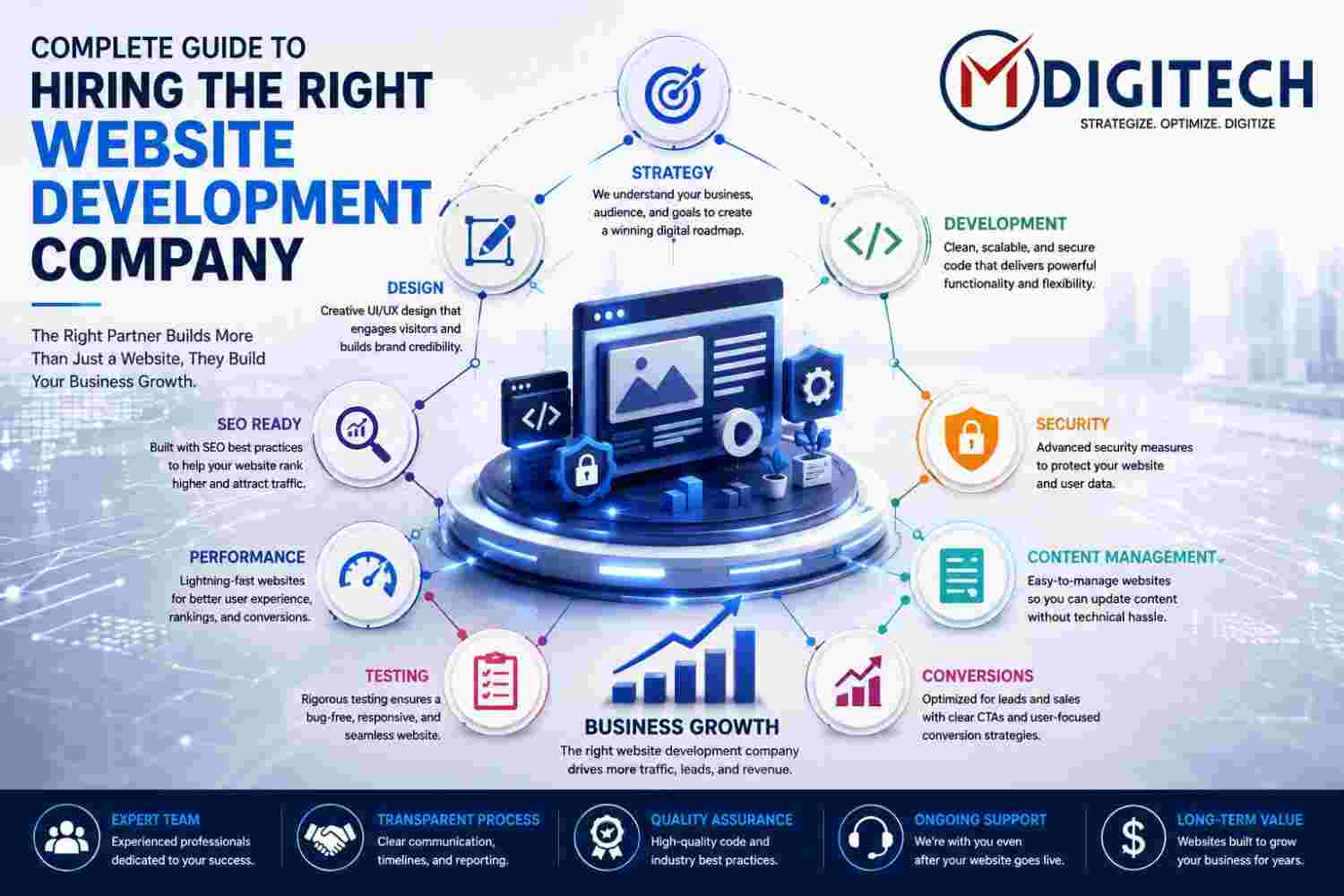
A business website often serves as the foundation of its digital presence, making the choice of a development partner a major decision. The right company can create a fast, secure, scalable, user-friendly website that supports marketing and sales goals. However, the wrong choice can lead to delays, unnecessary costs, technical problems, and poor performance. A structured hiring process helps businesses evaluate potential partners based on capabilities, communication, strategy, and long-term value rather than price alone.
Why Choosing the Right Website Development Company Matters
A website does much more than display information. It can attract prospects, generate leads, process transactions, support customers, and strengthen brand credibility.
Consequently, website development should align with broader business objectives. Design, technology, content, search visibility, performance, and conversion paths should work together.
Your Website Influences Customer Decisions
Visitors often form opinions about a business within moments of arriving on a website. Slow loading times, confusing navigation, outdated visuals, or unclear messaging can reduce trust and encourage visitors to leave.
In contrast, a well-planned website helps users find relevant information quickly. Clear navigation, persuasive content, strong calls to action, and responsive design can create a smoother path toward conversion.
Therefore, businesses should treat website development as a strategic investment rather than a simple design project.
Development Decisions Affect Future Growth
The technology and structure selected during development can influence future marketing efforts. Poor architecture may create technical SEO problems, limit integrations, slow future improvements, or make content management unnecessarily difficult.
Moreover, a scalable website can adapt as the business adds services, products, locations, content, or customer features. Planning for future needs can reduce the cost and disruption of major redevelopment later.
Start With Clear Business Objectives
Before contacting development companies, define what the website needs to accomplish. A project without clear objectives often expands unnecessarily because different stakeholders develop conflicting expectations.
Identify the Primary Purpose
A website may focus on one primary objective or several connected goals. Common purposes include:
- Generating qualified leads
- Selling products online
- Supporting local customers
- Building brand credibility
- Publishing educational content
- Providing customer support
- Booking appointments
- Recruiting employees
- Managing user accounts
- Supporting complex business operations
Once the primary purpose becomes clear, the development process becomes easier to evaluate.
Define Your Target Audience
The website should serve the people most likely to use it. Therefore, businesses should identify their target customers, common problems, questions, expectations, and preferred actions.
For example, a business-to-business website may need detailed service information and lead-generation forms. An ecommerce website may require product filtering, secure checkout, account features, and inventory integrations.
The development company should consider these differences before recommending a platform or feature set.
Create a Detailed Project Scope
A clear project scope helps both the business and the development company estimate costs, timelines, and technical requirements accurately.
Without sufficient detail, providers may make different assumptions. Consequently, proposals can vary significantly even when they appear to address the same project.
Include Essential Website Requirements
Your initial scope should identify important requirements such as:
- Approximate number of pages
- Required website features
- Ecommerce functionality
- User account requirements
- Third-party integrations
- Content management needs
- Mobile requirements
- Search optimization needs
- Analytics requirements
- Security expectations
- Accessibility considerations
- Ongoing maintenance needs
You do not need to specify every technical detail. However, the more clearly you communicate business requirements, the easier it becomes to compare potential partners.
Separate Essential Features From Future Ideas
Many website projects become delayed because teams attempt to include every possible feature before launch.
Instead, separate requirements into three groups:
- Essential for launch
- Valuable but not immediately necessary
- Possible future improvements
This approach helps control the initial budget. Moreover, a phased development plan can allow the business to collect user feedback before investing in additional functionality.
Look Beyond Design Portfolios
A visually attractive portfolio can demonstrate design capability, but appearance alone does not reveal how well a development company handles performance, security, usability, or technical complexity.
Therefore, evaluate completed work from multiple perspectives.
Review Functionality and User Experience
Visit example websites on both desktop and mobile devices. Consider whether navigation feels logical and whether important actions remain easy to complete.
Look for:
- Fast page loading
- Clear navigation
- Mobile responsiveness
- Consistent layouts
- Accessible content
- Logical calls to action
- Simple forms
- Secure interactions
- Effective search features
Moreover, examine whether the websites support the business goals of the organizations they represent.
Check Relevant Industry Experience
A company does not need experience in your exact industry to produce a strong website. However, relevant experience can help when the project includes specialized workflows, compliance requirements, integrations, or customer journeys.
For example, an ecommerce project requires different capabilities from a content-heavy publishing platform. Similarly, a complex service website may require advanced lead management and customer relationship integrations.
Relevant technical experience often matters more than superficial industry familiarity.
Evaluate Technical Capabilities
Technology should support business requirements rather than dictate them. A strong development partner should explain why a specific platform, framework, or architecture fits the project.
Ask About the Recommended Technology
Ask potential providers to explain:
- Why they recommend a particular platform
- Whether the website can scale
- How updates will be managed
- Who controls the hosting environment
- How security will be handled
- Whether the business can manage content
- How integrations will work
- What happens if future developers take over
Clear answers demonstrate planning. Vague responses may indicate that the provider has not fully considered the project’s long-term requirements.
Avoid Unnecessary Complexity
Complex technology does not automatically produce a better website. A smaller business may not need an expensive custom system when a reliable content management platform can meet its needs.
Conversely, forcing a complex enterprise requirement into a limited platform can create future problems.
The best solution should balance functionality, flexibility, cost, security, and maintainability.
Assess SEO During the Development Process
Search engine optimization should begin during planning rather than after the website launches. Technical decisions can affect crawlability, indexation, page speed, internal linking, and content visibility.
Ask How SEO Fits Into Development
A capable development process should address:
- Clean site architecture
- Logical URL structures
- Mobile usability
- Page performance
- Crawlable navigation
- Proper redirects
- Metadata controls
- Structured data capabilities
- XML sitemap generation
- Canonical management
- Indexation controls
Moreover, the company should coordinate with content and marketing teams when SEO requirements affect templates or information architecture.
Protect Existing Organic Visibility
Website redesigns and migrations can create major ranking losses when teams change URLs without proper planning.
Before launching a replacement website, the development team should identify important existing pages and create appropriate redirect plans. They should also test technical elements before and after launch.
Consequently, businesses can reduce unnecessary disruptions to organic traffic.
Ask About Website Security
Security should remain a core requirement throughout development. A vulnerable website can damage customer trust, interrupt operations, and create significant financial consequences.
Review the Security Approach
Ask how the company handles:
- Software updates
- User permissions
- Secure authentication
- Data protection
- Backups
- Malware prevention
- Security monitoring
- Plugin or extension management
- Hosting security
- Recovery procedures
The exact requirements depend on the website. However, every project should include a clear approach to ongoing protection.
Clarify Responsibility After Launch
Some companies provide ongoing maintenance, while others complete the project and transfer responsibility to the client.
Therefore, clarify who handles security updates and emergency issues after launch. A business should never assume that ongoing support automatically comes with the initial development fee.
Compare Pricing Carefully
Website development pricing can vary significantly based on complexity, customization, technology, integrations, content, and ongoing support.
A lower proposal may appear attractive. However, businesses should compare what each provider actually includes.
Review Every Proposal Line by Line
Compare:
- Discovery and planning
- Design work
- Development hours
- Content migration
- SEO implementation
- Testing
- Quality assurance
- Integrations
- Training
- Hosting
- Maintenance
- Post-launch support
Consequently, a higher-priced proposal may provide greater long-term value if it includes critical services that another provider charges separately.
Avoid Choosing Based Only on Price
The cheapest option can create additional costs through poor code, missed deadlines, weak security, or expensive future repairs.
Likewise, the highest price does not guarantee quality.
Instead, compare capabilities, processes, communication, deliverables, and long-term support. The goal should focus on value and suitability rather than simply finding the lowest quote.
Evaluate Communication and Project Management
Website development involves many decisions. Strong communication can prevent misunderstandings and keep the project moving.
Ask How the Project Will Be Managed
Clarify:
- Who will serve as the main contact
- How often updates will occur
- Which project management system will be used
- How feedback will be collected
- How approvals will work
- How scope changes will be handled
- Who makes final decisions
- How delays will be communicated
A defined process helps both sides maintain accountability.
Look for Clear and Direct Answers
Technical experts should explain important decisions in language that business stakeholders can follow.
If a company uses unnecessary jargon or avoids direct answers, communication problems may continue throughout the project.
However, clear communication does not mean avoiding technical detail. Instead, the provider should explain complex issues and connect them to practical business outcomes.
Review the Discovery and Planning Process
Strong development companies do not rush directly into design or coding. Planning helps identify requirements before expensive implementation begins.
What a Strong Discovery Phase Can Include
Depending on the project, discovery may involve:
- Stakeholder discussions
- Audience research
- Competitor review
- Website audits
- Content analysis
- User journey mapping
- Technical requirements
- Integration planning
- Sitemap development
- Conversion planning
Moreover, discovery can reveal conflicts between requested features and actual customer needs.
A well-planned project often avoids unnecessary revisions later.
Consider Conversion Rate Optimization
A website should make important actions easy. Whether the goal involves purchasing, contacting the business, booking an appointment, or requesting information, the development process should support conversion.
Focus on Customer Journeys
Map the steps visitors take from arrival to action.
For example:
Search → Landing Page → Relevant Information → Trust Signals → Call to Action → Form or Purchase → Follow-Up
Each stage should remove unnecessary friction.
Moreover, forms should request only essential information. Long forms can discourage prospects, while unclear calls to action can create hesitation.
Build Testing Into Future Plans
Not every conversion decision can be predicted before launch. Businesses should monitor user behavior and test important elements over time.
Potential testing areas include headlines, calls to action, page layouts, forms, offers, and navigation.
Consequently, the website can improve based on actual user behavior rather than assumptions.
Use Content Marketing to Support the Sales Funnel
Website development and content strategy should work together. A well-built website can support prospects from their first interaction through conversion and retention.
Attract Prospects at the Awareness Stage
Early-stage visitors often search for information, solutions, problems, and comparisons.
Useful content may include educational pages, service explanations, industry resources, and answers to common questions.
The goal should focus on providing value and building trust before demanding a sales commitment.
Support Evaluation and Consideration
As prospects compare options, provide deeper information that addresses their concerns.
Useful content can include:
- Detailed service pages
- Feature explanations
- Comparison content
- Process pages
- Case-based examples
- Pricing information
- FAQs
- Trust indicators
Moreover, clear internal links can move visitors toward pages that support the next decision.
Encourage Conversion
High-intent pages should make the next step obvious. Use clear calls to action, concise forms, relevant offers, and reassuring information.
A business looking for a top digital marketing agency would expect clear evidence of services, capabilities, processes, and measurable value. The same principle applies to any website: prospects need enough relevant information to act confidently.
Continue After the Initial Conversion
Customer relationships should not end when a visitor completes a form or purchase.
Thank-you pages, onboarding resources, follow-up emails, customer portals, and helpful support content can improve retention and encourage future engagement.
Consequently, the website can support the entire customer lifecycle.
Check Content Management Capabilities
A website should allow appropriate team members to update content without creating unnecessary technical barriers.
Ask Who Controls the Website
Clarify ownership of:
- Domain access
- Hosting accounts
- Source code
- Design files
- Content
- Analytics
- User accounts
- Third-party services
The business should retain appropriate control over essential assets.
Moreover, ask whether the platform allows staff to create new pages, update existing content, add media, and manage basic SEO elements.
Request Training
Training can reduce dependence on developers for routine changes.
Ask whether the development company provides documentation, recorded sessions, live training, or post-launch assistance.
Clear documentation can also help future employees and development partners work with the website more efficiently.
Ask About Testing and Quality Assurance
A website should go through structured testing before launch. Even attractive websites can contain broken forms, layout problems, slow pages, or browser compatibility issues.
Important Testing Areas
Quality assurance should review:
- Mobile devices
- Major browsers
- Forms
- Checkout processes
- User accounts
- Broken links
- Page speed
- Redirects
- Security features
- Accessibility
- Analytics tracking
Furthermore, testing should include real user scenarios whenever possible.
A successful launch requires more than confirming that pages display correctly.
Clarify Ownership and Contract Terms
Contracts should clearly define responsibilities, deliverables, timelines, payment schedules, intellectual property rights, and procedures for changes.
Pay Attention to Scope Changes
Website projects often change after development begins. Therefore, the contract should explain how additional requests will affect pricing and timelines.
A transparent change process protects both parties.
Review Payment Structure
Avoid agreements that create unnecessary financial risk.
Milestone-based payments can connect payments with completed phases. For example, payments may follow discovery, design approval, development, testing, and launch.
The appropriate structure depends on the project, but the agreement should clearly state what each payment covers.
Plan for Post-Launch Support
Launching the website represents the beginning of ongoing maintenance rather than the end of all technical work.
Identify Long-Term Needs
Post-launch services may include:
- Software updates
- Security monitoring
- Backups
- Performance optimization
- Bug fixes
- Content support
- Feature development
- SEO improvements
- Conversion testing
Therefore, ask for clear pricing and response expectations before the project ends.
Prepare for Future Growth
A website may need additional pages, integrations, products, locations, languages, or customer features.
The development partner should explain how future work can proceed without requiring a complete rebuild.
Scalability does not mean adding unnecessary complexity. Instead, it means creating a foundation that can accommodate realistic growth.
Red Flags When Hiring a Website Development Company
Certain warning signs can indicate potential problems before a contract begins.
Watch for companies that:
- Promise unrealistic timelines
- Guarantee search rankings
- Avoid discussing technical details
- Provide vague proposals
- Cannot explain pricing
- Refuse to clarify ownership
- Recommend technology without explaining why
- Offer no testing process
- Ignore security requirements
- Communicate inconsistently
- Push unnecessary features
- Provide no post-launch plan
One warning sign does not automatically mean the provider cannot perform well. However, several issues should encourage further evaluation.
A Practical Hiring Process
A structured process can reduce confusion and improve comparisons.
Step 1: Define Business Goals
Identify what the website must accomplish and how you will measure success.
Step 2: Prepare Requirements
Create a clear list of essential features, integrations, content needs, and future priorities.
Step 3: Shortlist Qualified Companies
Look for technical capabilities and relevant project experience rather than relying only on visual portfolios.
Step 4: Compare Proposals
Review scope, pricing, timelines, deliverables, testing, support, and ownership terms.
Step 5: Ask Detailed Questions
Evaluate communication quality and confirm how the provider approaches technical, SEO, security, and conversion requirements.
Step 6: Check the Contract
Confirm responsibilities before signing.
Step 7: Establish Communication Rules
Set approval processes, meeting schedules, and project responsibilities before development begins.
This structured approach can reduce unnecessary delays and improve project outcomes.
Frequently Asked Questions
1. How much does it cost to hire a website development company?
Costs vary according to design complexity, functionality, integrations, content requirements, technology, and support. A basic business website may require a smaller investment, while ecommerce platforms or custom applications can cost substantially more. Therefore, businesses should compare detailed scopes instead of evaluating providers solely by the final quoted amount.
2. How long does website development take?
Timelines depend on project size, content readiness, required features, integrations, approval processes, and revision cycles. A simple website may take several weeks, while complex projects can require several months. Moreover, delayed feedback or expanding requirements can extend the schedule, making clear project management essential.
3. Should I choose a custom website or a template-based solution?
The right option depends on business requirements. A template-based solution can reduce costs and speed development when standard functionality meets your needs. However, custom development may provide greater flexibility for unique workflows. Businesses should select technology based on requirements, scalability, budget, maintenance needs, and future growth plans.
4. Does a website development company handle SEO?
Some companies include technical SEO during development, while others provide only design and coding services. Therefore, ask exactly what SEO work the project includes. Important areas include site structure, redirects, performance, metadata controls, crawlability, mobile usability, and analytics. Content optimization may require separate strategic services.
5. Who should own the website and its assets?
The business should maintain appropriate control over essential assets, including domain access, hosting accounts, content, analytics, and agreed project files. Contract terms should clearly define ownership before development begins. Moreover, businesses should confirm whether they can move the website to another provider if future needs change.
6. How do I know whether a development company is reliable?
Review relevant work, evaluate communication, ask detailed technical questions, examine the proposal, and confirm how the company handles testing, security, ownership, and support. A reliable provider should explain its process clearly. Consequently, businesses can evaluate substance rather than relying only on attractive portfolio examples or sales promises.
7. Should I provide website content before development starts?
Early content planning helps developers create suitable page structures and layouts. However, every word does not need to be complete before development begins. Businesses should at least identify important pages, messaging priorities, conversion goals, and content responsibilities. Clear planning prevents content delays from disrupting the launch schedule.
8. What should happen after the website launches?
After launch, businesses should monitor performance, security, analytics, user behavior, conversions, and technical issues. Regular updates help protect the website and improve functionality. Moreover, ongoing SEO and content efforts can expand organic visibility. A post-launch plan ensures the website continues supporting changing business and customer requirements.
9. Can I change development companies later?
Yes, provided the contract and ownership arrangements allow the business to control essential assets. Before hiring, confirm access to domains, hosting, source code, design files, and third-party accounts. Clear ownership reduces dependency on a single provider and makes future transitions more manageable if business needs change.
10. What is the most important factor when hiring a development company?
The best choice combines technical capability, clear communication, relevant processes, realistic pricing, and alignment with business goals. No single factor provides a complete answer. However, a company that asks thoughtful questions, explains its recommendations, defines responsibilities, and plans for long-term success can provide greater value than one focused only on completing pages quickly.
Conclusion
Hiring a website development company requires more than comparing design samples and price quotes. The strongest decision starts with clear business objectives, detailed requirements, careful technical evaluation, and transparent communication. Moreover, SEO, security, conversion paths, content management, testing, and post-launch support should remain part of the process. By comparing providers based on long-term value and measurable business needs, companies can select a development partner capable of creating a website that supports growth, builds trust, and serves customers effectively.