Digital marketing pricing can feel confusing because agencies and freelancers use several billing structures for similar services. Some charge a fixed monthly retainer, while others bill by the hour, project, performance, or percentage of advertising spend. The right model depends on your goals, campaign complexity, internal resources, and expected return. Consequently, businesses should evaluate pricing alongside deliverables, reporting, expertise, flexibility, and measurable outcomes. A low fee does not automatically represent strong value, just as a high fee does not guarantee superior results. The smartest approach connects marketing costs with business objectives, customer acquisition goals, and sustainable revenue growth.
What Are Digital Marketing Pricing Models?
Digital marketing pricing models define how a provider charges for strategy, execution, management, creative work, advertising, optimization, and reporting. Therefore, the pricing structure directly affects your monthly budget, cash flow, expectations, and relationship with the marketing provider.
Different businesses need different arrangements. A local service company may prefer a predictable monthly retainer, whereas an ecommerce business might favor performance-based compensation. Meanwhile, a company launching a new website could select project-based pricing for a defined scope.
Why Pricing Structure Matters
Pricing determines more than the amount appearing on an invoice. It also influences accountability and the way both parties manage priorities.
A suitable model should provide:
- Clear deliverables and responsibilities
- Predictable or controllable costs
- Measurable performance expectations
- Reasonable flexibility as needs change
- Transparent reporting and communication
- A sensible relationship between spending and revenue
Moreover, businesses should separate marketing service fees from advertising budgets, software subscriptions, content production, and other campaign expenses. This distinction prevents misleading comparisons between providers.
Common Digital Marketing Pricing Models
Several pricing structures dominate the market. Each model serves a different business situation, so comparing them based solely on price can produce poor decisions.
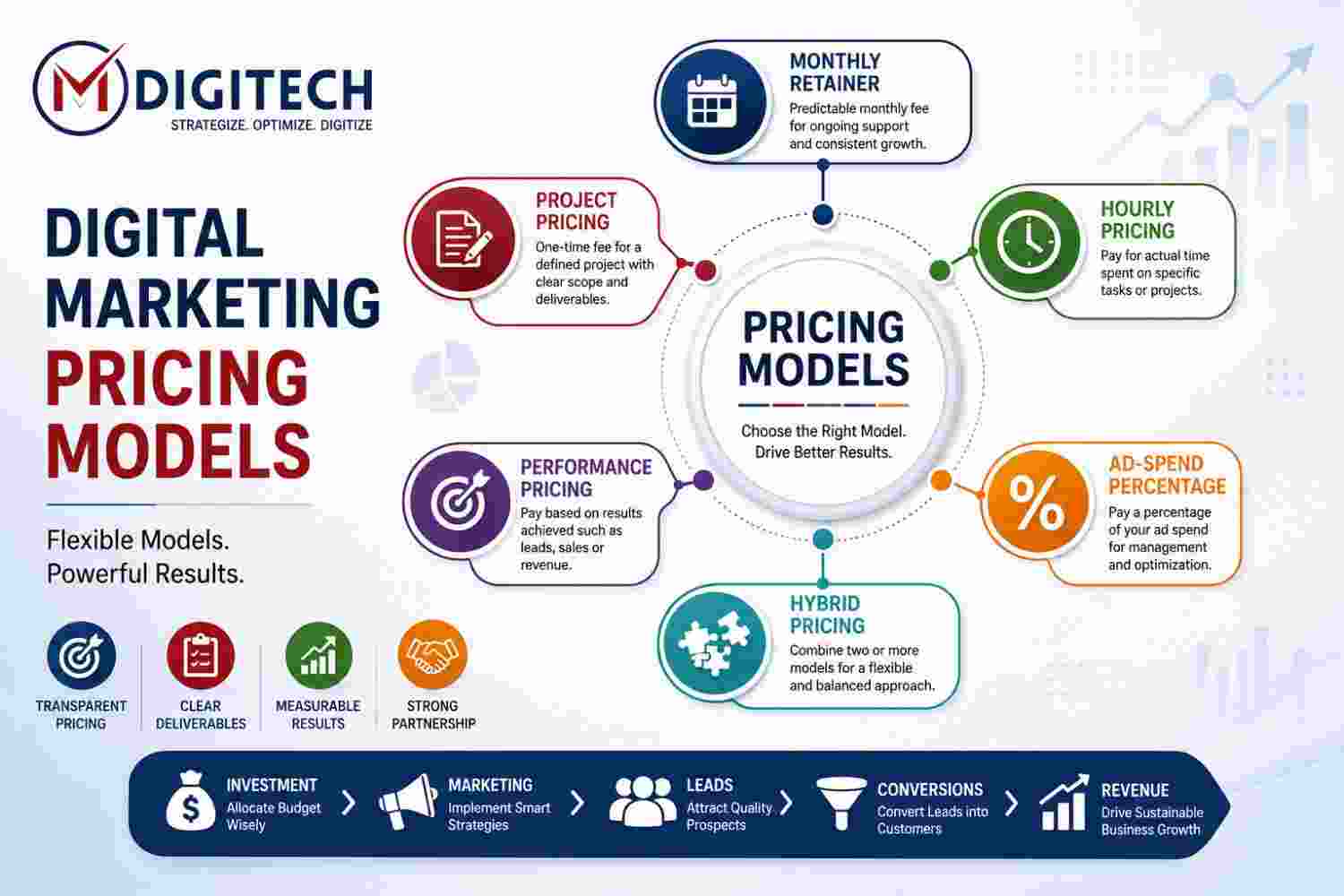
Monthly Retainer Pricing
A monthly retainer requires a recurring payment for an agreed set of marketing services. The provider typically establishes a monthly scope covering activities such as SEO, content marketing, paid advertising management, social media, analytics, conversion optimization, or strategy.
Retainers offer predictable budgeting because the business knows its recurring service cost. Furthermore, ongoing campaigns benefit from continuity because the marketing team can analyze results, refine campaigns, and maintain consistent execution.
However, businesses should confirm exactly what the retainer includes. A $2,000 monthly package and a $6,000 package may differ significantly in strategy depth, content volume, technical work, reporting, and campaign management.
Hourly Pricing
Hourly billing charges for the actual time a professional spends completing specific tasks. Businesses often use this model for consultations, audits, technical troubleshooting, strategy sessions, training, or specialized projects.
Hourly pricing provides flexibility because you can purchase expertise without committing to a large ongoing contract. However, costs can become difficult to predict when projects require extensive research, revisions, or unexpected technical work.
This model works particularly well when you already have an internal marketing team but need specialized assistance.
Project-Based Pricing
Project pricing establishes one fee for a clearly defined assignment. Website SEO audits, conversion optimization reviews, content strategies, keyword research projects, analytics setups, and website migrations often use this structure.
The major advantage involves cost clarity. You agree on the scope, timeline, deliverables, and price before work begins.
Nevertheless, project pricing requires careful scope definition. Additional requests can increase costs through change orders or separate invoices. Therefore, businesses should establish revision limits, deadlines, responsibilities, and acceptance criteria before approving the project.
Performance-Based Pricing
Performance pricing connects some or all compensation to specific outcomes. Depending on the agreement, those outcomes could include qualified leads, sales, appointments, revenue, or another measurable business objective.
This model can appear attractive because the business associates payment with results. However, marketing performance rarely depends on one party alone. Product quality, pricing, sales follow-up, website performance, market demand, seasonality, and customer service can influence outcomes.
Consequently, performance agreements require precise definitions. Both parties should establish attribution rules, measurement periods, baseline performance, eligible conversions, and payment conditions.
Percentage-of-Ad-Spend Pricing
Some providers charge a percentage of paid advertising expenditure. For example, a provider might charge a management fee based on the amount invested across search, social, display, or other advertising platforms.
This structure scales naturally with campaign size. If advertising expenditure increases, management revenue increases as well. Therefore, the provider has an incentive to support campaign growth, although responsible management should focus on profitable growth rather than spending more simply to increase fees.
Businesses should ask whether the percentage covers creative development, landing pages, tracking, testing, reporting, and optimization. Otherwise, additional charges may significantly increase the total cost.
Hybrid Pricing Models
Hybrid pricing combines two or more billing structures. A business might pay a fixed monthly strategy fee plus a percentage of advertising spend. Another arrangement could combine a base retainer with performance incentives.
Hybrid models often provide better balance because they compensate providers for ongoing work while rewarding specific outcomes.
However, complexity can create confusion. Every component should have a clear purpose, calculation method, and payment condition.
How Much Does Digital Marketing Cost?
Digital marketing costs vary considerably because businesses require different services, markets, campaign sizes, and levels of competition. Therefore, a single universal price cannot accurately represent the market.
A small business may allocate a modest monthly budget toward local SEO, content, and paid search. A growing company may invest substantially more across multiple channels. Meanwhile, enterprise organizations can require extensive technical SEO, content operations, analytics infrastructure, paid media management, and international campaigns.
Factors That Influence Pricing
Several variables affect digital marketing costs:
- Number of marketing channels
- Campaign complexity
- Geographic targeting
- Industry competition
- Content requirements
- Website size and technical condition
- Advertising budget
- Conversion goals
- Reporting requirements
- Required turnaround time
- Level of strategic involvement
- Internal team capabilities
Moreover, specialized services generally cost more when they require advanced technical knowledge, significant research, or senior strategic involvement.
Retainer vs. Project Pricing
Businesses often compare retainers with project pricing because both models appear frequently in digital marketing.
A retainer works best when marketing requires continuous optimization. SEO, paid media management, content marketing, and conversion optimization often benefit from ongoing attention because results develop through repeated testing and refinement.
Project pricing makes more sense when the business needs a defined deliverable with a clear beginning and end.
When a Retainer Makes Sense
Consider a retainer when you need:
- Continuous campaign management
- Ongoing SEO optimization
- Regular content production
- Continuous paid advertising optimization
- Monthly reporting and strategic planning
- Long-term conversion improvement
Consequently, retainers suit businesses that view marketing as an ongoing growth function rather than a one-time task.
When Project Pricing Makes Sense
Project pricing can work well for:
- SEO audits
- Website migrations
- Tracking implementation
- Keyword research
- Competitor analysis
- Conversion audits
- Marketing strategy development
However, a completed project does not necessarily produce lasting results. Businesses should consider what happens after implementation and whether internal staff can maintain the work.
Fixed Fees vs. Performance Pricing
Fixed fees offer predictable expenses, while performance pricing can connect compensation with measurable outcomes.
Fixed pricing provides greater financial certainty because the business knows what it will pay regardless of short-term campaign fluctuations. This structure also allows providers to focus on strategy rather than chasing individual conversions.
Performance pricing shifts some financial risk toward the provider. However, that risk can make providers selective about campaigns they accept. A provider may avoid businesses with weak websites, poor sales processes, unrealistic expectations, or limited conversion tracking.
Therefore, neither model automatically wins. The better choice depends on how clearly the business can measure outcomes and how much control each party has over those outcomes.
How to Evaluate a Marketing Proposal
A proposal should explain what you receive for your investment. Price alone provides little useful information without context.
Check the Scope of Work
Review every deliverable carefully. Look for specific quantities, timelines, channels, responsibilities, and reporting commitments.
For example, “SEO services” lacks detail. A stronger scope might identify technical audits, content optimization, internal linking, local optimization, reporting, and strategic recommendations.
Likewise, “social media management” should specify platforms, posting frequency, creative responsibilities, community management, and reporting.
Review Measurement and Reporting
Strong proposals explain how performance will be measured. Metrics should connect with business goals rather than focus exclusively on surface-level activity.
Useful metrics may include:
- Qualified leads
- Conversion rate
- Cost per acquisition
- Revenue generated
- Return on advertising spend
- Organic traffic growth
- Search visibility
- Customer acquisition cost
- Landing page performance
Moreover, reporting should explain what changed, why it changed, and what action follows from the data.
Red Flags in Digital Marketing Pricing
Extremely low pricing can create problems when providers reduce strategy, execution quality, communication, or reporting to maintain margins.
Be cautious when a proposal includes:
- Vague deliverables
- Guaranteed rankings
- Guaranteed revenue without conditions
- Unclear cancellation terms
- Hidden advertising fees
- Long contracts without performance reviews
- No access to campaign accounts
- Minimal reporting
- Excessive dependence on automated output
- Large upfront payments without defined milestones
A low-cost provider may still deliver excellent value, but businesses should evaluate the underlying scope rather than assume cheap means efficient.
Avoid Paying for Unnecessary Services
Marketing providers sometimes package services that do not align with business objectives. Consequently, businesses should ask why each service matters.
For instance, a company focused on local lead generation may gain more value from local search optimization and conversion improvements than from unrelated social activities.
The strongest pricing decision starts with the customer journey. Identify where prospects enter, what information they need, what objections prevent conversion, and which marketing activities can move them forward.
Using Content Funnels to Improve Marketing ROI
Content marketing can support every stage of the customer journey. Therefore, pricing decisions should consider whether content moves prospects toward meaningful actions rather than simply increasing publishing volume.
Top-of-Funnel Content
Prospects at the awareness stage usually need useful answers to problems, questions, and challenges.
Effective formats include:
- Educational blog content
- Search-focused resources
- Short videos
- Social content
- Industry explanations
- Problem-focused landing pages
The goal involves attracting relevant prospects without pushing aggressively for a sale.
Middle-of-Funnel Content
Once prospects recognize their problem, they need stronger evidence and practical information.
Consider:
- Comparison pages
- Case examples
- Checklists
- Webinars
- Detailed service pages
- Frequently asked questions
- Cost explanations
Moreover, this stage provides an opportunity to address objections involving pricing, timelines, risk, implementation, and expected outcomes.
Bottom-of-Funnel Content
Ready-to-buy prospects need confidence and a clear next step. Therefore, bottom-funnel content should emphasize value, proof, process, transparency, and action.
Useful assets include:
- Service pages
- Consultation pages
- Pricing pages
- Testimonials
- Demonstrations
- Proposal requests
- Contact forms
A strong funnel prevents businesses from spending heavily on traffic without creating an effective path toward conversion.
How Pricing Connects With ROI
Marketing costs only make sense when businesses compare them with commercial outcomes. A $5,000 monthly investment can represent strong value if it generates substantially more profitable revenue. Conversely, a $1,000 investment can waste money when it produces little qualified demand.
Calculate Customer Acquisition Cost
Customer acquisition cost, or CAC, measures the average amount spent to acquire a customer.
A basic calculation uses:
CAC = Total Marketing and Sales Costs ÷ New Customers Acquired
However, businesses should choose a consistent measurement period and include relevant costs. Comparing CAC against customer lifetime value provides a stronger financial perspective.
Consider Lifetime Customer Value
A customer who makes one purchase may produce less value than a customer who returns repeatedly.
Therefore, pricing decisions should consider retention, repeat purchases, referrals, average order value, and customer lifespan. This perspective can justify higher acquisition costs when the underlying customer economics remain profitable.
How to Negotiate Digital Marketing Pricing
Negotiation should focus on scope and value rather than simply demanding a lower price.
Instead of asking for a discount, consider adjusting:
- Number of channels
- Content volume
- Meeting frequency
- Reporting depth
- Project timeline
- Strategy involvement
- Service priorities
For example, a business could begin with two high-priority channels instead of funding five simultaneously.
Moreover, request clear milestones when a project involves significant investment. Milestones create accountability while giving both parties opportunities to assess progress.
Choosing the Right Pricing Model
The right pricing model depends on your business stage, goals, internal resources, risk tolerance, and measurement capabilities.
For Small Businesses
Small businesses often benefit from predictable retainers or focused project pricing. A narrow scope can prevent unnecessary spending while establishing a strong marketing foundation.
Local SEO, conversion optimization, targeted paid search, and high-value service pages may provide stronger commercial value than spreading a small budget across many channels.
For Growing Businesses
Growing businesses may benefit from retainers or hybrid models. As campaigns expand, ongoing strategy and optimization become increasingly important.
A business could combine a fixed strategic fee with channel-specific management costs while retaining flexibility for additional projects.
For Large Organizations
Larger organizations often require customized pricing because they manage multiple markets, websites, products, teams, and channels.
Enterprise arrangements may involve dedicated teams, extensive analytics, technical SEO, content operations, paid media, and specialized consulting. Consequently, pricing should reflect complexity, governance, reporting requirements, and business impact.
Questions to Ask Before Signing
Before approving a proposal, ask practical questions that expose the actual value behind the price.
Consider asking:
- What exactly does the monthly fee cover?
- Which costs remain outside the service fee?
- Who owns advertising and analytics accounts?
- How frequently will reporting occur?
- Which metrics determine success?
- How does the provider handle additional requests?
- What happens if priorities change?
- Can the agreement be canceled?
- Who creates and approves content?
- How will conversion tracking work?
These questions reduce uncertainty and create clearer expectations from the beginning.
How to Build a Sustainable Marketing Budget
A sustainable budget should reflect business economics rather than arbitrary industry averages.
Start by identifying revenue targets, average customer value, conversion rates, and acceptable acquisition costs. Then determine how much qualified traffic or lead volume you need to reach those targets.
For example, if a business needs 50 additional customers and historically converts 10% of qualified leads, it may need approximately 500 qualified leads. From there, the company can estimate required traffic, advertising expenditure, content production, and service costs.
Consequently, budgeting becomes a business planning exercise rather than a simple search for the cheapest provider.
Balance Short-Term and Long-Term Channels
Paid advertising can generate traffic quickly, while SEO and content marketing often require sustained effort. Therefore, businesses should consider a balanced channel mix.
A sensible allocation might combine immediate demand generation with long-term organic visibility and conversion improvement.
The ideal mix varies by business. Customer behavior, sales cycle, margins, competition, and existing brand visibility should shape the decision.
Why the Cheapest Option Can Cost More
Low pricing can become expensive when weak execution creates missed opportunities, wasted advertising expenditure, poor content, technical problems, or low-quality leads.
Furthermore, switching providers after months of ineffective work can create additional costs. Businesses may need to rebuild campaigns, correct tracking, rewrite content, recover website issues, or repair damaged customer trust.
That does not mean businesses should automatically choose the most expensive provider. Instead, evaluate expected value, transparency, expertise, scope, communication, and measurable outcomes together.
A top digital marketing agency should be judged by the clarity of its strategy and accountability, not simply by the size of its monthly fee.
Creating a Pricing Decision Framework
A simple decision framework can make vendor selection easier.
Step 1: Define the Business Objective
Specify whether the priority involves leads, sales, revenue, traffic, visibility, retention, or another measurable goal.
Step 2: Establish the Available Budget
Set a realistic range that protects cash flow while providing enough resources for meaningful execution.
Step 3: Select Appropriate Channels
Choose channels based on customer behavior and commercial potential rather than popularity.
Step 4: Compare Pricing Structures
Evaluate retainers, projects, hourly fees, performance pricing, percentage-of-spend models, and hybrids.
Step 5: Examine Deliverables
Compare actual work, not package names. Two providers can charge similar amounts while delivering dramatically different scopes.
Step 6: Assess Measurement
Confirm that tracking can connect marketing activity with meaningful business results.
Step 7: Review Flexibility
Make sure the agreement allows reasonable adjustments as business priorities evolve.
10 Frequently Asked Questions
1. What is the most common digital marketing pricing model?
Monthly retainers remain a common structure because businesses often require ongoing SEO, paid advertising, content, analytics, and optimization. Retainers provide predictable costs and allow providers to manage campaigns continuously. However, project, hourly, performance, and hybrid pricing can work better when businesses need specialized or short-term support.
2. How much should a small business spend on digital marketing?
There is no universal amount because budgets depend on revenue, margins, competition, customer value, and growth objectives. A small business should first identify its acceptable acquisition cost and expected return. Then it can allocate funds toward the channels most likely to generate qualified demand without creating unhealthy financial pressure.
3. Is performance-based pricing better than a monthly retainer?
Neither model automatically provides better value. Performance pricing can reduce upfront risk, but attribution can become complicated when multiple factors influence sales. Retainers provide predictable costs and support continuous strategic work. The best structure depends on measurable goals, tracking quality, provider responsibilities, and how much control each party has over outcomes.
4. What does a digital marketing retainer usually include?
A retainer may include strategy, SEO, content, paid advertising management, social media, analytics, reporting, conversion optimization, or a combination of these services. However, inclusions vary substantially. Businesses should request a detailed scope that specifies deliverables, service frequency, communication, reporting, revisions, and additional costs before signing.
5. Should advertising spend be included in the marketing fee?
Advertising spend and service fees should normally remain clearly separated because they represent different expenses. The advertising budget pays platforms to deliver campaigns, while the service fee compensates the marketing provider. Keeping these amounts separate improves financial visibility and makes provider comparisons easier.
6. Can digital marketing agencies guarantee results?
Responsible providers should avoid absolute guarantees because marketing outcomes depend on many variables outside their direct control. Market demand, competition, pricing, website performance, sales follow-up, and customer behavior can influence results. Instead, businesses should seek clearly defined objectives, measurable benchmarks, transparent reporting, and a practical optimization process.
7. How can I compare two marketing proposals?
Compare scope, strategy, deliverables, reporting, communication, contract terms, measurement, and total expected costs. Do not compare monthly prices alone. One proposal may include significantly more strategic work, content, technical optimization, or campaign management. Evaluate how each proposal connects marketing activity with your specific business objectives.
8. What makes a digital marketing pricing model transparent?
Transparency requires clear fees, deliverables, timelines, responsibilities, additional costs, contract terms, and measurement rules. Businesses should know exactly what they pay for and which expenses fall outside the agreement. Clear reporting also allows both parties to evaluate whether the investment produces meaningful progress.
9. Can I change pricing models later?
Many agreements allow pricing changes when both parties approve revised terms. However, businesses should address flexibility before signing. A company may begin with project pricing and later transition to a retainer when ongoing optimization becomes necessary. Contract language should clearly explain how scope and fees change.
10. How do I know whether marketing costs are producing value?
Connect marketing expenditure with qualified leads, customers, revenue, acquisition cost, conversion rates, and customer lifetime value. Avoid relying exclusively on traffic, impressions, followers, or rankings. These indicators can provide context, but financial outcomes offer stronger evidence of marketing effectiveness. Consistent tracking makes budget decisions more objective.
Conclusion
Digital marketing pricing should reflect business objectives, campaign complexity, expected value, and measurable outcomes rather than a simple monthly number. Retainers provide consistency, project fees offer defined scope, hourly billing delivers flexibility, and performance structures connect compensation with results. However, every model requires clear expectations and transparent measurement. Businesses can make stronger decisions by comparing deliverables, total costs, accountability, reporting, and customer acquisition economics. A well-structured marketing budget supports sustainable growth because it directs resources toward activities that attract qualified prospects, strengthen conversions, and create lasting commercial value.