Digital marketing has become a major investment for businesses that want to attract qualified customers, build visibility, and increase revenue online. However, the cost of digital marketing services varies widely based on the services required, business goals, industry competition, target market, and campaign complexity. A small local business may spend a few hundred dollars each month, while an established company with aggressive growth targets may invest thousands. Knowing what influences pricing makes it easier to set a realistic budget, compare service providers, and focus spending on marketing activities that can produce measurable business results.
Business Size and Marketing Goals
A small local business may need a focused SEO and paid search campaign, while a national company may require multiple channels, extensive content, technical optimization, analytics, and conversion testing. Consequently, larger campaigns require more resources.
Goals also influence pricing. Increasing brand awareness requires different tactics from generating qualified leads or driving direct online sales. Moreover, aggressive growth targets usually require greater investment in advertising, content production, testing, and campaign management.
Industry Competition
Competition strongly affects marketing costs. A business operating in a crowded industry may need more content, stronger backlinks, larger advertising budgets, and more sophisticated conversion strategies.
In contrast, a company serving a narrow local market may achieve meaningful visibility with a smaller investment. However, limited competition does not eliminate the need for quality execution.
Scope of Services
A single service usually costs less than an integrated marketing program. For example, monthly SEO management requires fewer resources than combining SEO, content, social media, email marketing, paid search, and conversion optimization.
Therefore, businesses should define exactly what they need before comparing proposals. Otherwise, two apparently similar quotes may cover completely different workloads.
Typical Digital Marketing Pricing Models
Providers commonly use several pricing structures. Each model can work well when the scope and deliverables remain clear.
Monthly Retainers
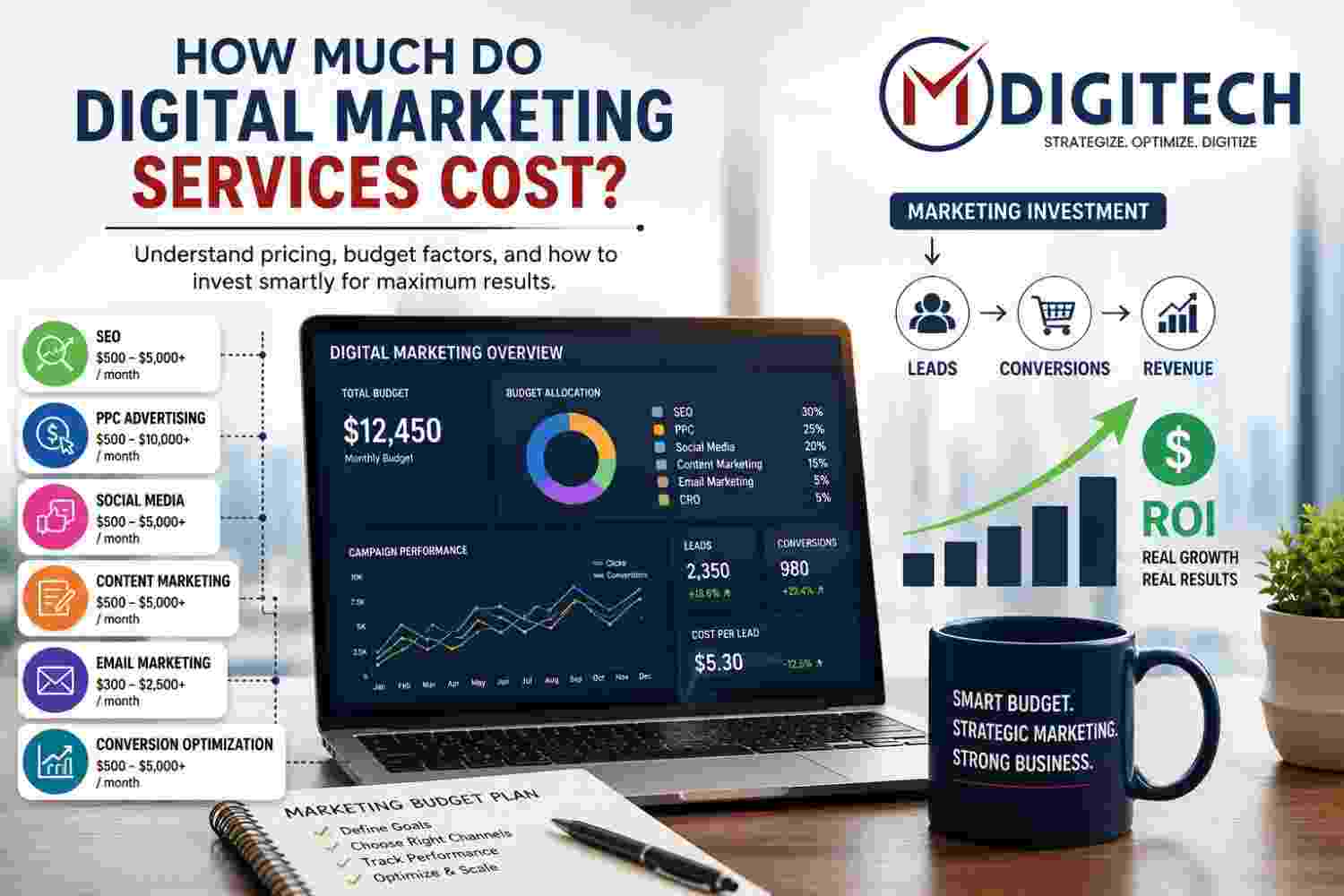
Monthly retainers remain common for ongoing SEO, content marketing, social media, and campaign management. Small businesses may spend roughly $500 to $2,500 per month for focused services, while established companies can invest $3,000 to $10,000 or more.
The actual fee depends on workload and market difficulty. Consequently, a higher retainer does not automatically produce better results. Businesses should evaluate deliverables, reporting, strategy, communication, and measurable objectives.
Hourly Pricing
Some consultants charge hourly rates, often ranging from approximately $75 to $250 or more. This structure can suit audits, consultations, technical troubleshooting, strategic planning, and short-term projects.
However, hourly pricing can become difficult to forecast when a project changes frequently. A clearly defined scope can make this model more predictable.
Project-Based Pricing
Businesses often choose project pricing for website SEO audits, technical implementations, content packages, landing pages, analytics setups, or marketing strategy development.
Depending on complexity, projects can cost several hundred dollars or exceed $20,000. Consequently, the proposal should identify deliverables, deadlines, revisions, responsibilities, and success measurements before work begins.
Performance-Based Pricing
Some providers connect compensation to leads, sales, or other performance indicators. Although this approach can appear attractive, businesses should examine the agreement carefully.
Attribution can create disputes when multiple marketing channels influence a conversion. Therefore, performance-based contracts need precise definitions, tracking systems, payment rules, and realistic expectations.
How Much Do Individual Services Cost?
Different digital marketing services require different levels of expertise and resources. The following ranges provide useful planning benchmarks rather than universal prices.
Search Engine Optimization
Small businesses often spend approximately $500 to $3,000 per month on ongoing SEO. Larger campaigns can exceed $5,000 monthly when they involve technical SEO, content production, digital PR, extensive research, and competitive national markets.
SEO typically includes keyword research, technical improvements, content optimization, internal linking, local optimization, reporting, and authority development. Moreover, meaningful organic growth usually requires consistent effort rather than a short campaign.
Pay-Per-Click Advertising
Paid search management may cost $500 to $3,000 or more per month, excluding advertising spend. Some providers charge a percentage of ad spend, while others use flat fees.
Advertising budgets vary dramatically. A small local campaign might require $1,000 monthly, whereas a competitive national campaign may require $10,000, $50,000, or considerably more.
Businesses should separate management fees from media spending because they represent different investments.
Social Media Marketing
Social media management can cost roughly $500 to $5,000 monthly, depending on the number of platforms, posting frequency, creative requirements, community management, and strategic involvement.
Basic management may cover scheduling and captions. More advanced programs can include original graphics, short-form video, influencer coordination, paid campaigns, audience research, and detailed reporting.
Content Marketing
Content marketing pricing varies according to format and quality. Blog content may cost anywhere from $100 to $1,000 or more per piece, while strategic content programs can require several thousand dollars each month.
High-value content often involves research, expert input, editorial review, optimization, design, distribution, and conversion planning. Consequently, businesses should evaluate content by its ability to attract qualified visitors and support business objectives, not simply by word count.
Email Marketing
Email marketing management can range from $300 to $3,000 or more per month. Costs depend on list size, campaign frequency, automation, segmentation, copywriting, design, testing, and platform complexity.
A basic newsletter program requires fewer resources than a sophisticated lifecycle system. Moreover, automated sequences can create substantial value because they continue engaging prospects after initial acquisition.
Website and Conversion Optimization
Website improvements can range from $1,000 for focused optimization work to $20,000 or more for substantial redesigns and conversion projects.
Costs increase when businesses require custom development, technical integrations, analytics implementation, landing-page testing, accessibility improvements, or advanced personalization.
How Much Should a Small Business Budget?
Small businesses should avoid spreading limited resources across every marketing channel. Instead, they should identify the channels most closely connected to customer behavior and revenue.
Starter Budget: $500 to $1,500 Monthly
A modest budget can support one primary channel and basic measurement. Local businesses might prioritize local SEO, Google Business Profile optimization, content improvements, or tightly targeted paid search.
At this level, consistency matters more than channel volume. Therefore, concentrating resources often produces better results than maintaining weak campaigns everywhere.
Growth Budget: $1,500 to $5,000 Monthly
A growing business can combine two or three channels. For example, SEO can attract organic traffic while paid search captures immediate demand and email marketing nurtures prospects.
Furthermore, this budget can support stronger content production, conversion optimization, analytics, and regular strategic reviews.
Scaling Budget: $5,000+ Monthly
Businesses pursuing aggressive growth may allocate $5,000 to $20,000 or more across multiple channels. Such programs can include technical SEO, content operations, paid media, remarketing, social campaigns, landing-page testing, and advanced analytics.
At this level, businesses need stronger attribution and financial controls. Otherwise, additional spending can increase activity without increasing profitable revenue.
What You Actually Pay For
Marketing fees cover much more than visible deliverables. Behind each campaign sits research, planning, execution, measurement, and ongoing optimization.
Strategy and Research
Effective campaigns require audience research, competitor analysis, market positioning, keyword research, customer journey mapping, and channel selection.
Without this foundation, businesses can spend heavily on tactics that attract attention but fail to generate qualified opportunities.
Creative Production
Campaigns may require copywriting, graphics, photography, video, landing pages, lead magnets, advertisements, and email assets. Consequently, creative complexity can significantly increase costs.
Technology and Analytics
Marketing teams often use analytics platforms, advertising systems, SEO software, customer relationship management tools, email platforms, heatmaps, reporting systems, and automation technology.
These tools support better decisions, although businesses may pay separately for software subscriptions.
Optimization and Reporting
Campaign management involves reviewing performance, identifying problems, testing alternatives, and reallocating resources. Monthly reports also help stakeholders connect marketing activity with business outcomes.
A provider that simply delivers a report without recommendations offers limited strategic value.
How to Compare Digital Marketing Proposals
Price comparisons become easier when every proposal uses similar evaluation criteria. Before signing a contract, review:
- Exact services included
- Monthly deliverables
- Expected communication frequency
- Reporting format
- Key performance indicators
- Contract duration
- Setup or onboarding fees
- Advertising spend
- Software costs
- Content production limits
- Revision policies
- Cancellation terms
- Ownership of accounts and creative assets
Moreover, ask how the provider defines success. Traffic alone may look impressive while producing few leads or sales.
How to Calculate a Sensible Marketing Budget
A practical budget should connect marketing investment with customer economics.
Start With Customer Value
Calculate the average revenue or gross profit generated by a customer. Then estimate how much you can reasonably spend to acquire that customer while maintaining acceptable margins.
For example, if a customer generates $2,000 in gross profit, spending $500 to acquire that customer may work financially if retention and fulfillment support the model.
Set Channel-Specific Targets
Each channel should have measurable objectives. SEO may focus on qualified organic traffic and conversions. Paid advertising may focus on cost per lead or return on ad spend. Email marketing may focus on revenue per subscriber.
Consequently, businesses can identify weak channels before they consume excessive resources.
Reserve Money for Testing
A marketing budget should not fund only proven campaigns. Set aside a portion for controlled experiments involving landing pages, creative concepts, audiences, offers, and messaging.
However, testing should follow clear hypotheses and measurement rules rather than random experimentation.
Content Marketing Funnel Tips That Improve ROI
Content can support every stage of the customer journey when businesses match topics with user intent.
Top of Funnel
Attract prospects with educational content that addresses problems, questions, comparisons, and early research needs. Search-focused blog content, videos, social posts, and downloadable resources can create initial awareness.
The goal at this stage remains useful attention rather than an immediate sales pitch.
Middle of Funnel
Once prospects show interest, provide stronger evidence. Case studies, comparison pages, webinars, checklists, email sequences, and detailed service explanations can address objections and demonstrate credibility.
Moreover, clear calls to action can move qualified visitors toward consultations, demos, quotes, or product evaluations.
Bottom of Funnel
High-intent prospects need decision-support content. Service pages, pricing information, testimonials, FAQs, guarantees, process explanations, and comparison content can reduce uncertainty.
A business competing with a top digital marketing agency should not rely solely on broad promotional claims. Instead, it should demonstrate relevant expertise, transparent processes, measurable outcomes, and clear value.
Retention and Advocacy
The funnel should continue after conversion. Email education, onboarding content, customer resources, loyalty campaigns, and referral programs can increase retention and customer lifetime value.
Consequently, marketing costs become more efficient when businesses generate repeat purchases and referrals from existing customers.
Signs You May Be Overspending
High marketing expenditure does not always indicate strong performance. Watch for warning signs such as:
- Increasing traffic with declining conversions
- Rising advertising costs without stronger revenue
- Large content volumes with little qualified traffic
- Unclear campaign ownership
- Reports filled with vanity metrics
- Long contracts without meaningful performance reviews
- Frequent strategy changes without testing
- Spending across too many channels
- No connection between marketing and sales data
If these problems appear, reassess the strategy before increasing the budget.
Signs Your Marketing Budget May Be Too Low
Underinvestment can also restrict growth. A budget may prove inadequate when campaigns lack enough data for meaningful optimization, content production remains inconsistent, advertising cannot generate sufficient impressions, or technical problems remain unresolved.
However, increasing spending alone will not solve poor strategy. Fix targeting, messaging, offers, tracking, and conversion barriers before adding significant funds.
How Long Does It Take to See Results?
Timeframes vary by channel and market. Paid advertising can generate traffic quickly, while SEO and content marketing often require several months of consistent work before producing substantial organic growth.
Moreover, conversion improvements can create faster gains when a business already receives qualified traffic. Businesses should therefore set realistic milestones for visibility, engagement, leads, sales, and profitability rather than expecting every channel to mature at the same pace.
How to Maximize Marketing ROI
Strong returns usually come from disciplined execution rather than simply increasing expenditure.
Prioritize the channels with proven customer demand. Track conversions from the first interaction through revenue whenever possible. Improve landing pages before dramatically increasing traffic. Repurpose successful content across email and social channels. Furthermore, review underperforming campaigns regularly and redirect resources toward stronger opportunities.
Clear positioning also matters. When prospects immediately see who you serve, what problem you solve, and why your solution fits their needs, conversion rates can improve without requiring proportional increases in traffic.
Choosing the Right Pricing Structure
No single pricing model works for every business. Monthly retainers suit companies that need continuous optimization and strategic support. Project pricing works well for defined deliverables. Hourly consulting can suit specialized problems or short assignments.
Performance-based arrangements may fit mature businesses with reliable tracking systems, but they require careful contractual terms.
Ultimately, the right structure should provide predictable costs, transparent responsibilities, measurable objectives, and enough flexibility to respond to performance data.
10 Frequently Asked Questions
1. What is the average cost of digital marketing services?
Many small and midsized businesses spend between $1,000 and $5,000 per month across selected digital marketing services. However, costs vary according to industry competition, business size, service scope, advertising spend, and growth targets. A focused campaign can cost less, while sophisticated national programs can require substantially larger monthly investments.
2. Is digital marketing worth the cost for a small business?
Digital marketing can provide strong value when the strategy targets channels that customers actually use. Small businesses should prioritize measurable activities such as local SEO, paid search, email marketing, or conversion optimization. Moreover, tracking leads and revenue helps determine whether marketing spending produces sufficient returns rather than relying on traffic alone.
3. How much should a startup spend on digital marketing?
A startup can begin with approximately $500 to $2,500 monthly, depending on its market and acquisition goals. The business should prioritize one or two channels rather than spreading resources too thinly. As campaigns generate reliable data and revenue, the startup can gradually increase spending while maintaining acceptable acquisition costs.
4. Does SEO cost more than paid advertising?
Neither service has a universally higher cost. SEO usually requires ongoing investment in technical work, content, optimization, and authority development, while paid advertising requires both management fees and media spending. SEO can build long-term organic visibility, whereas paid advertising can generate targeted traffic faster when campaigns receive adequate funding.
5. Why do digital marketing agencies charge different prices?
Agencies differ in staffing, specialization, service scope, technology, market focus, reporting standards, and strategic involvement. Therefore, two providers may quote different prices for apparently similar services. Businesses should compare deliverables, expertise, accountability, communication, and measurement instead of selecting a provider solely because it offers the lowest monthly fee.
6. Can I do digital marketing myself?
Business owners can handle basic marketing tasks themselves, particularly social posting, email newsletters, simple content, and local profile updates. However, technical SEO, advanced advertising, analytics, conversion testing, and large content programs can require specialized skills. As business demands increase, outsourcing selected functions may provide better efficiency and consistency.
7. Should advertising costs be included in the marketing budget?
Yes. Businesses should include advertising spend when calculating the total acquisition budget, but they should track media spending separately from management fees. This separation shows how much money goes toward buying exposure versus strategy and execution. Consequently, decision-makers can evaluate channel efficiency and provider performance more accurately.
8. How can I avoid wasting money on digital marketing?
Set measurable goals before launching campaigns, establish conversion tracking, define target audiences, and review performance regularly. Avoid paying for activities that lack a clear business purpose. Furthermore, request transparent deliverables and reporting. If a provider cannot explain how its work supports leads, sales, retention, or profitability, reconsider the investment.
9. How long should I hire a digital marketing provider?
The appropriate commitment depends on the service. Paid campaigns can receive meaningful performance data within weeks, while SEO and content programs often require longer periods. A reasonable agreement should include review points and measurable milestones. Therefore, businesses can evaluate progress without locking themselves into an inflexible arrangement.
10. What matters more: marketing budget or marketing strategy?
Strategy determines how effectively a budget gets used. A large budget cannot compensate for poor targeting, weak messaging, ineffective offers, or broken conversion paths. Conversely, a focused strategy can produce meaningful results with limited resources. Once a campaign demonstrates positive economics, increasing investment can help scale its strongest opportunities.
Conclusion
Digital marketing costs depend on far more than a monthly service fee. Business size, competition, channel selection, workload, technology, creative requirements, and growth targets all influence the final investment. Therefore, businesses should judge marketing costs against qualified leads, revenue, customer lifetime value, and profitability.
A sensible budget starts with clear objectives, focused channels, accurate tracking, and realistic expectations. Moreover, consistent optimization helps every dollar work harder. When businesses connect marketing spending with measurable commercial outcomes, they can make better investment decisions and build a stronger foundation for sustainable growth.