Hiring a marketing agency can strengthen your brand, increase qualified leads, and improve revenue. However, the wrong partnership often wastes time, drains budgets, and delays business growth. Many agencies make impressive promises, yet fail to deliver measurable outcomes. Careful evaluation helps you avoid expensive mistakes while choosing a partner that aligns with your goals. At the same time, applying smart content marketing funnel strategies allows you to attract stronger prospects and convert them into loyal customers with greater consistency.
Why Choosing the Right Marketing Agency Matters
Every marketing investment should support measurable business objectives. A reliable agency builds strategies based on research, customer behavior, and realistic expectations. Meanwhile, an unreliable partner often focuses on flashy presentations instead of meaningful performance.
Although many agencies offer similar services, their execution, communication, and accountability vary significantly. Consequently, selecting the right partner requires more than comparing pricing or attractive proposals.
An effective agency should:
- Define realistic business goals.
- Build customized marketing strategies.
- Communicate clearly and consistently.
- Provide transparent reporting.
- Adapt campaigns based on performance.
- Focus on sustainable long-term growth.
Strong partnerships create momentum instead of confusion. Therefore, evaluating potential agencies carefully before signing any agreement remains one of the smartest business decisions.
The Most Common Red Flags Before Signing a Contract
Many warning signs appear during early conversations. Paying attention to these details can prevent costly disappointments later.
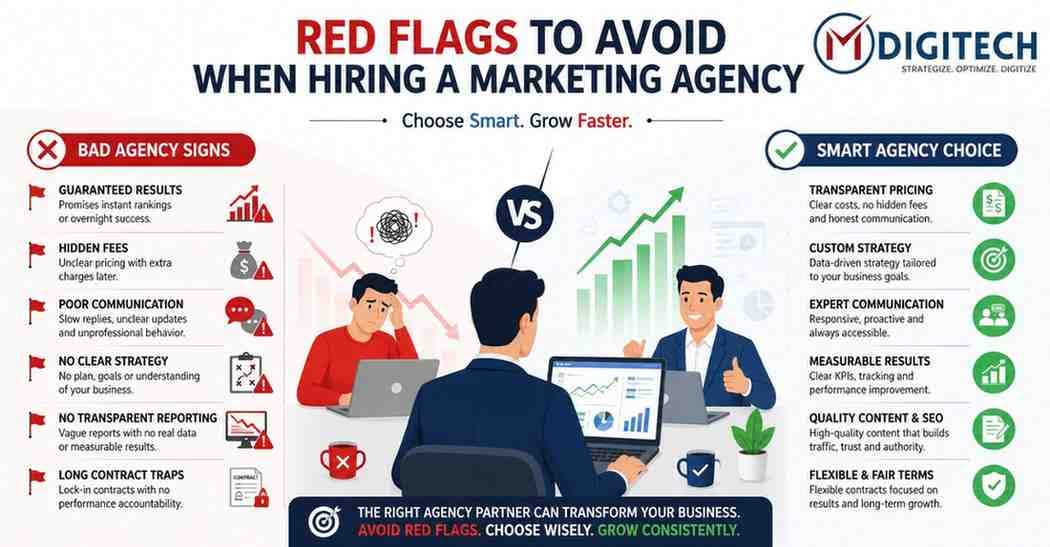
Guaranteed Rankings or Instant Success
No agency controls search engine algorithms or customer behavior. Therefore, anyone promising guaranteed first-page rankings or overnight growth should raise immediate concerns.
Marketing success depends on many factors, including competition, website quality, audience behavior, content quality, and consistent optimization. Honest professionals explain these realities instead of selling unrealistic expectations.
Look for agencies that discuss:
- Gradual improvements
- Long-term strategy
- Performance benchmarks
- Continuous optimization
- Risk management
Real growth develops over time rather than through shortcuts.
Lack of Clear Strategy
Some agencies jump directly into campaign execution without explaining their overall plan. However, every successful campaign begins with a structured strategy.
A dependable agency should explain:
- Target audience research
- Competitive analysis
- Content planning
- Search optimization
- Lead generation process
- Conversion strategy
- Performance measurement
Without these elements, campaigns often become disconnected activities that produce inconsistent results.
Poor Communication During Sales
The sales process often reflects the future working relationship.
If emails receive delayed responses, meetings feel rushed, or questions remain unanswered, communication problems may continue after the contract begins.
Reliable agencies usually:
- Respond promptly.
- Answer questions clearly.
- Set realistic timelines.
- Explain technical concepts simply.
- Establish communication expectations.
Consequently, businesses gain confidence before committing to a long-term partnership.
Hidden Pricing and Unclear Contracts
Pricing transparency builds trust from the beginning.
Unfortunately, some agencies present attractive initial quotes while hiding additional charges inside lengthy contracts. Unexpected expenses often appear after campaigns begin, creating frustration and budget challenges.
Before signing, request clarification regarding:
- Monthly management fees
- Setup costs
- Advertising management
- Content production
- Website updates
- Contract duration
- Cancellation policies
- Ownership of creative assets
Moreover, every cost should appear clearly in writing. Transparent agencies welcome these discussions because they value long-term relationships over short-term sales.
Long-Term Contracts Without Performance Accountability
Extended contracts are not automatically problematic. However, agreements that lock clients into lengthy commitments without measurable performance standards deserve careful review.
Healthy partnerships include:
- Regular performance reviews
- Clearly defined objectives
- Flexible optimization
- Honest reporting
- Reasonable exit options
These elements encourage accountability while protecting both parties.
Limited Transparency in Reporting
Marketing decisions depend on reliable data.
If an agency avoids sharing campaign performance, reporting methods, or important metrics, clients cannot accurately evaluate progress.
Meaningful reports should include information such as:
- Website traffic trends
- Lead generation
- Conversion rates
- Search visibility
- Campaign performance
- Return on investment
- Goal completion
Furthermore, reports should explain what happened, why it happened, and which improvements will follow. Numbers without context rarely support better business decisions.
Confusing Reports Filled With Technical Language
Some agencies overwhelm clients with complicated terminology instead of delivering meaningful insights.
Professional reporting should simplify complex information rather than complicate it.
Ask whether reports answer practical business questions, including:
- Which campaigns generated leads?
- Which pages converted visitors?
- Where did customers come from?
- Which channels produced the highest value?
- What changes improved results?
Simple explanations often indicate stronger strategic thinking.
Weak Content Strategy Signals Bigger Problems
Content supports nearly every digital marketing channel. Therefore, weak content planning usually reflects broader strategic weaknesses.
A capable agency creates content with specific objectives instead of publishing random topics.
Quality planning should include:
- Audience research
- Search intent analysis
- Content clusters
- Editorial planning
- Conversion opportunities
- Performance measurement
Without structured planning, businesses often publish content that attracts little traffic and generates few qualified leads.
Quantity Over Quality
Publishing more content does not automatically improve performance.
Some agencies focus only on production volume because it appears impressive during monthly reporting. However, low-quality content often creates poor engagement, weak authority, and lower conversion rates.
Instead, evaluate whether the agency emphasizes:
- Original research
- Helpful information
- Strong organization
- Clear calls to action
- Consistent quality standards
Better content usually produces stronger long-term results than frequent low-value publishing.
No Interest in Your Business Goals
Marketing should support business objectives rather than operate independently.
If an agency spends most conversations discussing its own services instead of your company, priorities may already be misaligned.
Strong agencies ask thoughtful questions regarding:
- Revenue goals
- Customer profiles
- Competitive challenges
- Sales process
- Existing marketing efforts
- Customer retention
- Growth priorities
These conversations create customized strategies rather than generic campaign templates.
Generic Recommendations for Every Client
Every business serves different audiences, faces unique competitors, and operates within distinct markets.
Consequently, identical recommendations rarely produce exceptional results.
Customized planning should address:
- Industry competition
- Local or national targeting
- Customer journey
- Budget allocation
- Seasonal demand
- Business objectives
Businesses seeking a top digital marketing agency should prioritize strategic thinking over polished presentations because thoughtful planning consistently produces stronger long-term outcomes.
Ignoring the Complete Customer Journey
Many agencies focus only on generating traffic. Unfortunately, visitors alone rarely produce meaningful business growth.
Successful marketing considers every stage of the buying process.
Awareness Stage
Potential customers first recognize a problem or opportunity.
Effective awareness content should:
- Answer common questions.
- Address customer concerns.
- Build credibility.
- Improve visibility.
- Encourage further engagement.
Rather than pushing immediate sales, this stage builds trust that supports future purchasing decisions.
Consideration Stage
Once prospects compare available options, they seek more detailed information.
Businesses should provide:
- Educational resources
- Service comparisons
- Helpful checklists
- Frequently asked questions
- Practical solutions
Consequently, prospects gain confidence while moving closer to making informed purchasing decisions.
Decision Stage
The final stage determines whether a prospect becomes a customer. At this point, confidence matters more than promotion. Every interaction should remove uncertainty and reinforce the value of your services.
High-converting decision-stage content often includes:
- Detailed service pages
- Transparent pricing information
- Client success stories
- Clear calls to action
- Simple contact options
- Consultation invitations
Moreover, every conversion point should make the next step obvious. Complicated forms, vague messaging, or unnecessary barriers frequently reduce conversion rates.
Content Marketing Funnel Tips That Convert Prospects
Generating traffic means little without a strategy that moves visitors toward action. A structured content marketing funnel creates momentum by delivering the right information at the right time.
Create Content for Every Funnel Stage
Many businesses focus almost exclusively on attracting new visitors. However, prospects need different information as they move through the buying process.
Balance your content with:
- Educational blog posts
- Industry insights
- Comparison pages
- Frequently asked questions
- Case studies
- Service explanations
Consequently, each visitor finds relevant information regardless of where they enter the funnel.
Use Clear Calls to Action
Every page should encourage a logical next step. Rather than overwhelming visitors with multiple choices, guide them toward one primary action.
Effective calls to action may encourage readers to:
- Request a consultation
- Schedule a meeting
- Download a resource
- Contact the sales team
- Request a proposal
Simple, direct language often performs better than overly creative wording.
Build Trust Before Asking for Commitment
Trust develops through consistency. Therefore, businesses should demonstrate expertise before requesting significant commitments.
Helpful trust-building elements include:
- Honest messaging
- Transparent pricing when appropriate
- Clear service descriptions
- Helpful educational content
- Consistent branding
- Fast response times
As confidence increases, prospects become more comfortable taking the next step.
Questions to Ask Before Hiring an Agency
The interview process should reveal how an agency thinks, communicates, and solves problems. Asking thoughtful questions often exposes weaknesses that polished presentations hide.
Consider asking:
- How do you define campaign success?
- Which metrics receive the highest priority?
- How frequently will reporting occur?
- Who will manage the account?
- How do you adjust underperforming campaigns?
- What communication process do you follow?
- How do you research target audiences?
- What happens if goals are not met?
Furthermore, evaluate how clearly each answer addresses your business objectives instead of relying on generic sales language.
How to Compare Agencies Objectively
Comparing proposals becomes easier when every agency receives the same evaluation criteria.
Review each candidate based on:
- Strategic planning
- Communication quality
- Industry knowledge
- Reporting transparency
- Content capabilities
- Technical expertise
- Pricing clarity
- Long-term scalability
In contrast, selecting a partner based solely on the lowest price often creates higher costs through poor execution and missed opportunities.
Building a Long-Term Marketing Partnership
Successful relationships continue long after campaigns launch. Regular collaboration allows both parties to identify opportunities, solve challenges, and improve results over time.
Healthy partnerships share several characteristics:
- Mutual accountability
- Open communication
- Realistic expectations
- Continuous optimization
- Data-driven decisions
- Shared business goals
Moreover, agencies should welcome feedback and recommend improvements instead of maintaining outdated strategies. Flexibility supports sustainable growth as markets, customer behavior, and business priorities evolve.
Conclusion
Hiring a marketing agency requires careful evaluation rather than quick decisions. By recognizing warning signs early, asking better questions, and focusing on transparency, strategy, and accountability, businesses can avoid costly mistakes. A structured content marketing funnel further strengthens every marketing investment by turning interested visitors into qualified prospects and loyal customers. Careful planning, honest communication, and measurable performance remain the foundation of lasting marketing success.
Frequently Asked Questions
1. What is the biggest red flag when hiring a marketing agency?
The biggest warning sign is an agency that guarantees specific rankings, instant growth, or unrealistic results. Marketing depends on many changing factors, so trustworthy agencies focus on measurable progress, strategic planning, and continuous improvement instead of making promises that no one can reliably control.
2. Why is transparency important when choosing a marketing agency?
Transparent agencies explain pricing, reporting, timelines, and campaign strategies clearly. This openness builds confidence and helps businesses make informed decisions. Clear communication also prevents unexpected costs, misunderstandings, and unrealistic expectations throughout the partnership.
3. How can I tell if an agency understands my business?
A strong agency asks detailed questions about your goals, customers, competitors, and sales process before suggesting solutions. Customized recommendations usually indicate genuine interest, while generic proposals often suggest a one-size-fits-all approach that may not deliver meaningful results.
4. Should I avoid agencies with long-term contracts?
Long-term contracts are not necessarily negative. However, agreements should include performance reviews, clear deliverables, reasonable cancellation terms, and measurable objectives. Flexible partnerships often encourage better accountability than restrictive contracts with limited client protections.
5. Why are regular reports so important?
Consistent reporting helps businesses evaluate campaign performance and identify opportunities for improvement. Useful reports explain key metrics, highlight progress toward goals, and recommend practical next steps rather than presenting raw data without meaningful context.
6. How does content marketing help generate more leads?
High-quality content answers customer questions, builds credibility, and supports every stage of the buying journey. As prospects gain confidence, they become more likely to engage with your business, request additional information, and eventually make purchasing decisions.
7. What should I expect during the first meeting with an agency?
The initial discussion should focus on your business objectives, target audience, competitive landscape, budget, and growth priorities. An effective agency spends more time asking thoughtful questions than delivering a generic sales presentation.
8. Can a low-cost agency still provide excellent results?
Affordable pricing does not automatically indicate poor quality. However, businesses should evaluate strategy, communication, reporting, and expertise alongside cost. Long-term value usually matters more than selecting the lowest available price.
9. How often should a marketing strategy change?
Marketing strategies should evolve based on performance data, customer behavior, and changing business objectives. Regular reviews help identify successful tactics while allowing underperforming activities to be refined before they waste additional resources.
10. What makes a marketing partnership successful over time?
Successful partnerships rely on honest communication, shared objectives, consistent optimization, transparent reporting, and mutual accountability. Both parties should collaborate regularly, measure meaningful outcomes, and adjust strategies whenever business conditions or customer needs change.