How to Hire a Digital Marketing Agency for Real Business Growth
Business growth depends on smart decisions, and choosing the right partner can shape long-term success. Many brands search for the best digital marketing agency to improve visibility and revenue. That decision requires clarity, research, and a structured approach rather than guesswork.
A marketing agency influences brand positioning, customer acquisition, and revenue streams. A poor choice leads to wasted budgets, missed opportunities, and slow growth. A strong choice builds momentum, credibility, and measurable results.
This piece breaks down everything required to make the right hiring decision, from defining goals to evaluating performance.
Why Businesses Choose Digital Marketing Agencies
Companies hire agencies to fill skill gaps, save time, and scale faster. Internal teams often struggle to manage SEO, paid ads, content, analytics, and social media together. Agencies bring specialized expertise and tested systems.
Here’s what drives most hiring decisions:
- Access to experienced professionals
- Cost-effective compared to in-house teams
- Faster execution of campaigns
- Advanced tools and analytics
- Scalable strategies
Agencies also bring an external perspective, which helps identify missed opportunities and improve existing strategies.
Step 1: Define Clear Business Goals
Before reaching out to any agency, define what success looks like. Vague goals lead to vague results.
Ask yourself:
- Do you want more website traffic?
- Do you need higher conversion rates?
- Do you want to build brand awareness?
- Are you launching a new product?
- Do you need better lead quality?
Clear goals help agencies design targeted strategies. For example, increasing traffic requires SEO and content marketing, while boosting conversions may need landing page optimization and paid campaigns.
Write down measurable goals such as:
- Increase organic traffic by 40% in 6 months
- Generate 100 qualified leads per month
- Reduce cost per acquisition by 20%
Defined metrics allow both sides to track progress effectively.
Step 2: Set a Realistic Budget
Budget plays a crucial role in selecting the right agency. Low budgets limit options and results, while unrealistic expectations create frustration.
Break your budget into categories:
- Paid advertising spend
- Agency fees
- Tools and software
- Content production
Understand pricing models:
- Retainer-based: Monthly fixed fee
- Project-based: One-time payment
- Performance-based: Linked to results
Choose a structure that aligns with your goals and risk tolerance.
Avoid choosing an agency solely based on the lowest price. Cheap services often lead to poor-quality work and minimal ROI.
Step 3: Evaluate Core Services
Not all agencies offer the same services. Some specialize in SEO, while others focus on paid advertising or social media.
Key services to consider:
- Search Engine Optimization (SEO)
- Pay-Per-Click Advertising (PPC)
- Social Media Marketing
- Content Marketing
- Email Marketing
- Conversion Rate Optimization (CRO)
- Analytics and Reporting
Choose an agency that aligns with your needs instead of a one-size-fits-all provider.
If your goal is long-term growth, prioritize SEO and content marketing. If you want quick results, paid advertising becomes essential.
Step 4: Check Industry Experience
Experience matters, but relevance matters more. An agency that understands your industry can deliver faster results.
Look for:
- Case studies from similar industries
- Proven results with measurable outcomes
- Knowledge of your target audience
However, avoid limiting yourself only to industry-specific agencies. A fresh perspective from another sector can sometimes lead to innovative strategies.
Focus on problem-solving ability rather than just past clients.
Step 5: Review Case Studies and Results
Case studies reveal how an agency approaches challenges and delivers results. They provide real evidence instead of promises.
A strong case study includes:
- Client problem
- Strategy implemented
- Execution process
- Measurable results
Look for numbers such as:
- Traffic growth percentage
- Lead generation increase
- Revenue improvement
- ROI from campaigns
Avoid agencies that provide vague claims without data.
Step 6: Understand Their Strategy Approach
A reliable agency builds strategies based on research, not assumptions.
Ask these questions:
- How do you conduct market research?
- How do you identify target audiences?
- What tools do you use for analysis?
- How do you measure success?
A good agency explains its process clearly. It does not rely on buzzwords or generic plans.
Strategy should include:
- Competitor analysis
- Audience segmentation
- Channel selection
- Content planning
- Performance tracking
Transparency in strategy reflects professionalism.
Step 7: Assess Communication and Transparency
Strong communication builds trust and ensures alignment. Poor communication leads to confusion and delays.
Evaluate:
- Response time
- Clarity in explanations
- Reporting structure
- Availability for meetings
You should receive regular updates, including:
- Weekly or monthly reports
- Campaign performance insights
- Recommendations for improvement
Avoid agencies that avoid questions or provide unclear answers.
Step 8: Analyze Tools and Technology
Digital marketing relies heavily on tools for data tracking and execution.
Common tools include:
- SEO tools for keyword tracking
- Analytics platforms for user behavior
- Ad platforms for campaign management
- Automation tools for email marketing
Ask which tools the agency uses and how they apply insights.
Advanced tools improve efficiency, accuracy, and results.
Step 9: Evaluate Team Expertise
An agency’s strength lies in its team. Skilled professionals drive better outcomes.
Look for:
- Specialists in SEO, PPC, and content
- Experienced strategists
- Data analysts
- Creative designers
Avoid agencies where one person handles everything. Specialized roles ensure quality work.
Ask about team structure and who will handle your account.
Step 10: Check Client Reviews and Testimonials
Client feedback provides real insights into an agency’s reliability.
Look for:
- Consistent positive feedback
- Long-term client relationships
- Honest reviews mentioning strengths and weaknesses
Do not rely only on testimonials published on their website. Look for independent reviews if possible.
Patterns in feedback reveal the true performance of an agency.
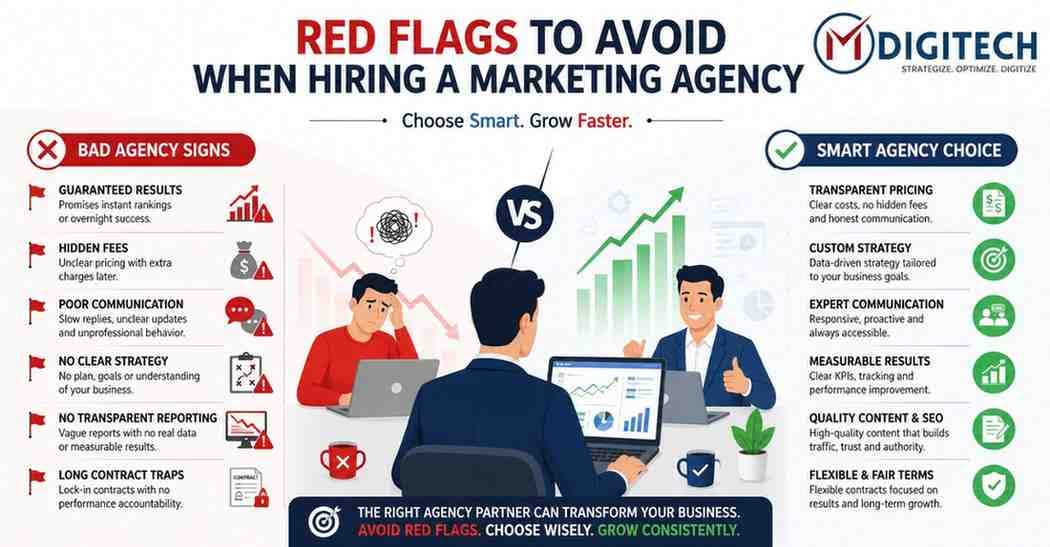
Red Flags to Watch Out For
Not every agency delivers what it promises. Watch for warning signs before signing a contract.
Common red flags include:
- Guaranteed rankings or instant results
- Lack of clear strategy
- Poor communication
- No case studies or proof
- Overpromising with low pricing
Digital marketing requires time and consistency. Avoid unrealistic promises.
Questions to Ask Before Hiring
Asking the right questions helps you evaluate an agency effectively.
Here are essential questions:
- What results have you achieved for similar clients?
- How do you measure success?
- What is your reporting process?
- Who will manage my account?
- How do you handle challenges or underperformance?
Their answers should be clear, specific, and backed by examples.
Contract and Agreement Essentials
A clear contract protects both parties and sets expectations.
Important elements include:
- Scope of work
- Deliverables
- Timelines
- Payment terms
- Termination clauses
Avoid vague agreements. Everything should be documented.
Read the contract carefully before signing.
Onboarding Process
A structured onboarding process ensures a smooth start.
Typical onboarding steps include:
- Business analysis
- Goal alignment
- Strategy planning
- Tool setup
- Initial campaign launch
A professional agency takes time to understand your business before executing campaigns.
Rushed onboarding often leads to poor results.
Measuring Performance and ROI
Tracking performance ensures accountability and improvement.
Key performance indicators (KPIs):
- Website traffic
- Conversion rates
- Cost per acquisition
- Return on investment (ROI)
- Engagement metrics
Regular reports should include insights, not just numbers.
Focus on outcomes rather than vanity metrics.
Long-Term Partnership vs Short-Term Engagement
Digital marketing delivers better results over time. Long-term partnerships allow consistent growth and optimization.
Benefits of long-term collaboration:
- Better understanding of your brand
- Continuous strategy improvement
- Stronger results over time
Short-term projects work for specific campaigns, but long-term engagement builds sustainable success.
Customization Over Templates
Every business has unique goals and challenges. Avoid agencies that offer generic packages without customization.
A tailored approach includes:
- Industry-specific strategies
- Target audience analysis
- Custom content plans
- Personalized campaigns
Customization ensures better alignment and higher ROI.
Collaboration with Your Internal Team
An agency should work as an extension of your team, not a separate entity.
Effective collaboration includes:
- Regular communication
- Shared goals
- Feedback loops
- Transparent processes
Strong collaboration improves efficiency and results.
Scaling with the Right Agency
As your business grows, your marketing needs evolve. A good agency adapts and scales strategies accordingly.
Scaling involves:
- Expanding marketing channels
- Increasing ad budgets
- Improving automation
- Entering new markets
Choose an agency that can grow with your business.
Conclusion
Hiring a digital marketing agency requires careful planning and evaluation. The right partner aligns with your goals, communicates clearly, and delivers measurable results.
Avoid rushing the decision. Focus on strategy, transparency, and proven performance. A well-chosen agency becomes a growth partner that drives long-term success.
The effort you invest in selecting the right agency directly impacts your business outcomes. Make the decision with clarity, research, and confidence.